⚡️Energy Issues of 2019: Batteries, Blockchain & Microgrids

Moving into 2019, I will keep my eyes on the following issue:

  1. 🔋Batteries

Batteries are what will enable a sustainable energy future for us by tackling the ongoing problem of intermittency. Since solar and wind energy are intermittent 💡 (in a nutshell: if the sun stops shining because it’s cloudy, your solar panel stops producing electricity), they cannot be fully integrated into the baseload energy supply (powered by coal, gas, dams and other “reliable” sources). With batteries, you collect energy and store it for later use, the same way a water canister collects rainwater for later use.

Renewables – Storage = NOT A COMPLETE SOLUTION

 

s-l1600.jpg
Alessandro Volta, inventor of the battery


Right now: the lights that are currently on in your house or office have been generated by electricity produced moments ago. This is how our gird works, supply must meet demand, and the electricity that is not used is wasted.

Currently, the best most extensively used technology we have got on the market is the lithium-ion battery. As the cost of production of these batteries continues to fall, Elon Musk (founder of Tesla) believes that lithium-ion battery costs will fall to $100/KWh by 2020, dropping from a price of $1,000 only as recently as 2010. Bloomberg forecasts battery storage costs to drop below $50 by 2030. As of today, the cost is in the $200 range. As the cost continues to drop, renewable energy sources will become increasingly cost competitive with conventional energy production. Moreover, the growth of electric vehicles (EV) is driving lithium-ion battery production. EVs currently make up only roughly 1% of all vehicles, but that will change rapidly. According to a McKinsey & Company, the EV segment of the light-duty vehicle market could reach 20% by 2030, pushing the need to develop, better and cheaper batteries further.

But lithium-ion batteries are not the only game in town. There are many companies operating in the in the hot sector, a notable one being Ambri, the liquid metal battery startup which spun out of MIT materials research, which received funding from the likes of Bill Gates. Other battery companies, in the last two years have for different reasons gone under, such as the Aquion saltwater battery, Alevo filing for bankruptcy, LightSail burning through its cash for its compressed air storage; ViZn Energy is on its last legs looking for new funding for its flow battery.

The challenge for the non-lithium ion startups lays in demonstrating that their battery is significantly less expensive than the lithium-ion one and can perform over a long lifetime with limited degradation. This is an enormously technically challenging for now.

       2. Digitalization: Microgrids, Blockchain Technology, Data

Digitalization is an umbrella term thrown around by people in different sectors. In the context of energy, digitalization groups developing technologies such as microgrids*, Internet of Things (IoT), Big Data and Peer to Peer Technology, which improve efficiency and reduce costs.

This is a rapidly evolving area which is positioned to shift our energy system away from its centralized one-way street structure. It wants to shift our reliance on power stations and energy retailers, cutting out the middleman (and the associated cost) and moving us to more decentralized energy distribution.

⚡️Wholesale electricity distribution⚡️

Technology has the tendency to cut out the middleman , in this case, its the  energy retailers.  The end goal of blockchain and microgrids is to enable consumers to buy and trade directly from the grid, making traditional energy retailers unnecessary.  The marketplace would be made up of consumers who buy and sell to each other based on their respective energy needs. This would significantly more cost-effective and energy efficient, because connecting local use and production with local grids, can allow us to achieve local balance.

I already can hear the, “But this would be terribly inconvenient! Wouldn’t buying electricity when you need it be totally impractical-besides how am I even supposed to know how much to buy and when?!

Not at all. Not if we have an IoT (Internet of Things) device that automatically buys it for when you need it and how much you need. A device could be built into our homes, which would electricity when it’s cheapest at low demand, stores it in a battery, and then sells it back to the grid when energy is expensive at high demand.

In such a case blockchain technology would be the “middleman”.

Peer to Peer (P2P) Energy
Screenshot 2019-02-03 at 15.13.04
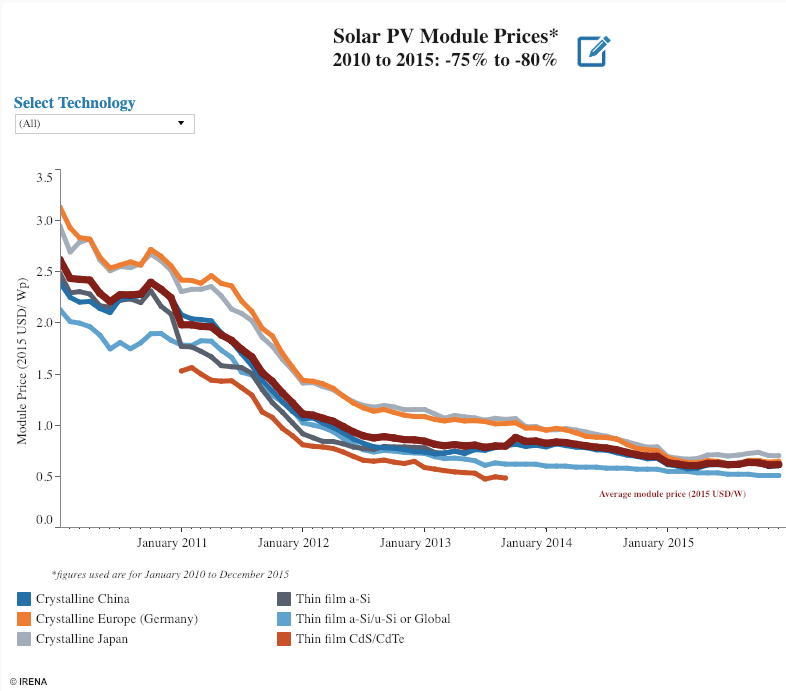
Solar PV Price Decline

With the boom in solar panel installations and with the exponential decline in prices,  we are not just energy consumers anymore — we are also the producers. If there are multiple people who produce energy in your neighbourhood, with their private solar panels, then you have a theoretical market place.

💡Case in point: I have solar panels on my roof to power my house.  If I have leftover energy from my solar panels, it is sold back to the grid. Due to inefficiencies and high distribution costs in this process, I am not making much money.

With P2P energy, I could sell this leftover energy to my neighbour using blockchain technology. Because the blockchain acts as the middleman in this transaction, I would make more money selling it to my neighbour than I would selling it back to the grid. This is because:

  • It’s cheaper for the neighbour to buy energy from me rather than our energy retailer. My neighbour can support renewables if they themselves do not have solar panels
  • It’s a more eco-friendly and more efficient use of electricity as less energy is lost along during the transmission from power station to the house, since the electricity would be traveling from my house to the neighbours house

On a small and local scale, there are pioneering companies that are already doing this in the US and in Australia.

Right now, microgrids are an additional grid which operates in parallel with the current grid. But P2P blockchain companies anticipate this to evolve into larger, more distributed, interconnected microgrids.

📈Data is King 

The energy sector collects enormous amounts of data on a continuous basis, thanks to the application of sensors, wireless transmission, network communication, and cloud technology. Data is being collected on both the supply and demand sides.

Data is only valuable if you know how to use it. The challenge rests in understanding how to harness this information in an efficient manner. But companies are starting to understand what this data can do for them and for the economy as a whole.

The only way to give this technology true value is to enable a statistical big data approach to it.

Intelligence comes from algorithms and self-learning, and from using data collected from sensors, databases, users, and meters.

As we gather and store information taken out of the energy system and smart meters, we can also compare that information to data that comes from weather patterns or consumer behavior.

By combining data streams, consumers and energy companies can be more efficient, make better use of their availability and aggregate capacity at the right time, in the right moment of the market, at the highest value, and create a better balance between demand and supply.

💡Case in Point: Devices in my house knows at what temperature I turn the heating on in my house, before I turn it on, and predict weather events, such as snowstorms which would trigger me to switch the heating on. The device would then, preemptively buy electricity at lower demand and store it in a battery for when the snowstorm arrives and the prices are higher.

Digitalization is already providing new opportunities for suppliers by optimizing their valuable assets, integrating renewable energies from different resources, and reducing operational costs; at the same time, it favors consumers by reducing the energy bills.

——

*If you are unfamiliar with microgrids and the implications that they will have (dare I say, are having) please check out my previous articles on the subject, The Energy Infrastructure That the U.S. Really Needs and🇺🇸Mr. Trump, Make The Grid Great Again!
🇩🇪Not all that Glitters is Green: German Renewables surpass coal in Electricity Generation⚡️

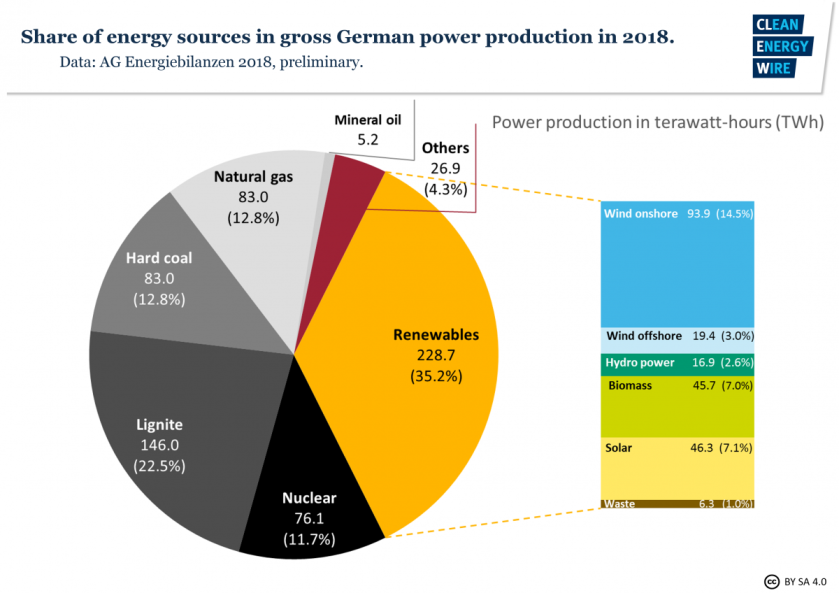
According to the Munich based Fraunhofer Institute, Germany’s renewables generated more electricity than coal in 2018 for the first time ever, with renewables providing 40% of the annual produced electricity and coal provided just 38%.

Note that, “renewables” is a general term that includes different sources—solar, wind, hydroelectric, and biomass (mostly wood pellets)—while coal is just a single fuel source meaning that renewables have not displaced fossil fuels, just coal.

The growth in renewables can be attributed, in part, to:

  • a prolonged hot sunny summer across Germany helping produce more renewable energy this year than last year, increasing solar output, by adding 3.2 gigawatts (GW) of solar to an existing 45.5 GW last year.

The remainder of Germany’s 2018 electricity production came from gas plants and nuclear plants.

While Germany did break ground, and on its own, this is great news, there are two sides to this story that make this achievement less impressive then it sounds.

✨All that glitters is not green✨

For starters, it stands to reason that if the solar energy grew, at least in part because of favourable weather rather then sustainable growth, then this growth is accidental rather then structural. So what could have been expected of those figures had the summer been rainy and cloudy?

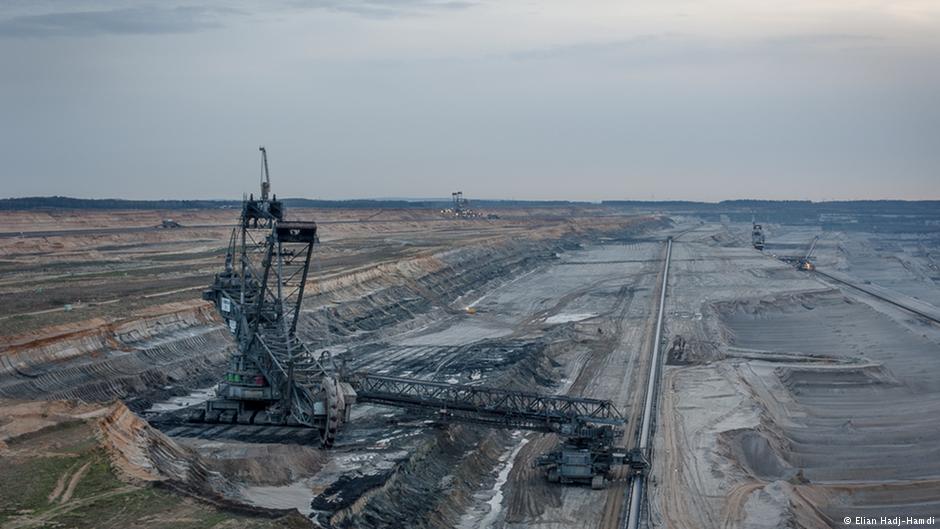
Secondly, coal and lignite* (dirtiest of all fossil fuels with relation to carbon dioxide emissions — but also the cheapest) still account for more than 1/3 of Germany’s electricity needs. Closing all of the country’s roughly 120 coal-fired power plants may take over 20 years, according to the government. Moreover, in 2011, following the Fukushima accident, the government decided to shut down 20% of the country’s nuclear reactors and close the rest by 2022. With nuclear on its way out, can we realistically 11.7% of Germany’s energy mix to replaced by renewables in a timely manner?

fig3_share_of_energy_sources_in_gross_german_power_production_2018.png


💸High Cost for Low Rewards?💸

Former Green environment minister Jürgen Trittin famously said that the burden placed on German households by the renewable energy surcharge would amount to “only around one euro per month, the price of a scoop of ice cream.” But the regular addition of renewables to the German power grid meant that the German taxpayer’s electricity bill was quickly inflated by the renewables surcharge, making Trittin’s well-intentioned comparison obsolete and quasi-comical.

Let me be clear: public dialogue about the energy transition’s price tag is propelled by a characteristic of Germany’s payment system green energies: consumers pay a renewables surcharge in their electricity bills. While this method may be more transparent than many alternatives based on direct state subsidies, it also elicits public debates about the costs. If the German electricity generation is what it is today, we have the German taxpayers to thank for it.

As of 2018,  the surcharge made up 23% of the power price paid by an average household. In other words, German electricity bills would be 23% cheaper if renewables did not exist altogether. However, new research led by Alberto Gandolfi from Goldman Sachs, shows that from now onwards the marginal capacity that is going to be added to the system is going to be deflationary, meaning that the surcharge accounts for old and less efficient renewable energy, and the new highly efficient renewable which will be added from now onwards will have to potential to decrease the surcharge.

Bearing in mind that the cost of solar PV has plummeted by about 80%, wind (both offshore and onshore) has dropped by about between 50% and 70% since 2010, therefore Gandolfi’s research seems likely to materialize in the near future.

Nevertheless, in spite of the higher energy bills, public opinion has remained supportive of the energy transition. Research conducted in 2017 by the Institute for Advanced Sustainability Studies in Potsdam found that 88% of those surveyed support the strategy to cut emissions.

Bear in mind that the energy transition’s costs are difficult to quantify. Estimates of the total amount of annual investment vary from 15 to 40 billion euros or 0.5% to 1.2% of Germany’s current GDP of around 3,200 billion euros.

Missed Targets

The German Bundestag has committed to reducing Germany’s greenhouse gas emissions by 40% by 2020, by at least 55% in 2030, by at least 70% in 2040 and by 80-95% in 2050 compared to 1990 levels. Germany’s ambitious targets also sought to reduce German dependence on imported energy, to shift electricity from fossil fuels to green sources, to make transportation and buildings more energy efficient.

Germany’s progress in achieving its targets if falling widely short of expectations. The government recently admitted that they will fall short of their 2020 target by 8%, achieving only 32% reduction of emissions since 1990 vs. the 40% target and will thus fail to meet its goals as set out in the 2015 Paris Agreement.

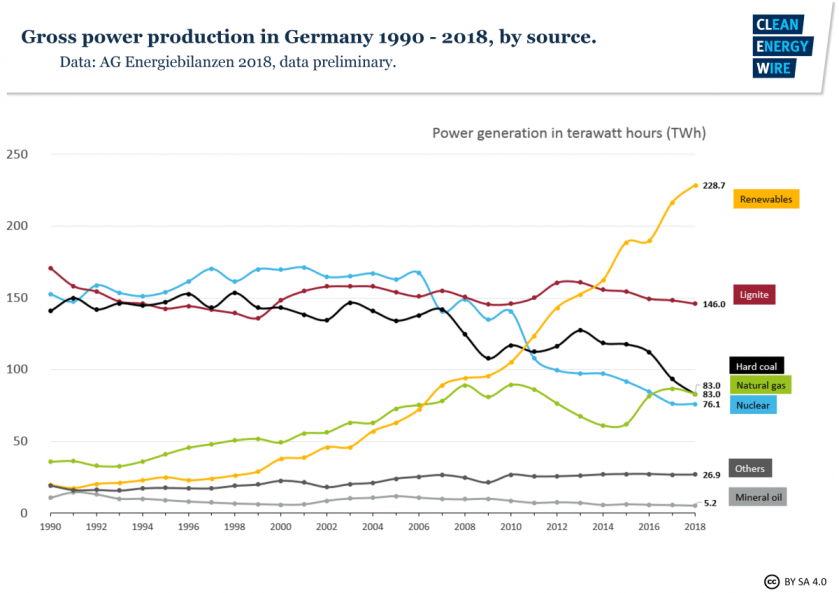
fig2a_gross_power_production_in_germany_1990_2018.png

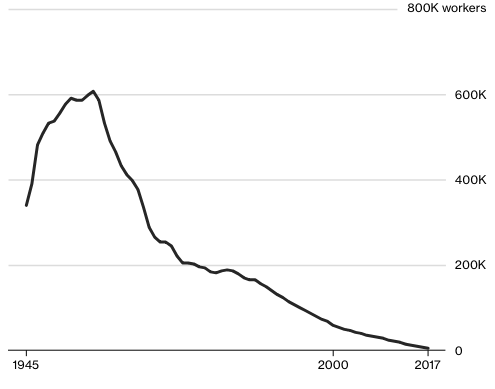
If we look above at the above electricity production for Germany, coal (meaning Hard coal and Lignite) plays an enormous role. While Hard coal consumption has dropped, lignite has not decreased significantly. The reason for this is that lignite coal is too cheap and reliable. The second reason is that touching lignite is a sensitive political issue, even in Germany, due to the roughly 22,500 people whose jobs depend on it. Although employment in the coal industry is on its way out (see above below), the jobs are located in economically fragile areas, where losses would be felt deeply.

German Coal Employment

Screen Shot 2019-01-05 at 12.29.36.png
source: Statistik der Kohlenwirtschaft e.V., chart from Bloomberg

However, the relative cheapness of lignite is explained by the fact the price of carbon is not factored into its price. This means that is we were to see the real price of coal, with the price of pollution factored into it, it would not be cheap at all. In any case, the market favours “cheap coal” and this is why its use has barely decreased, despite falling profits from coal plants.

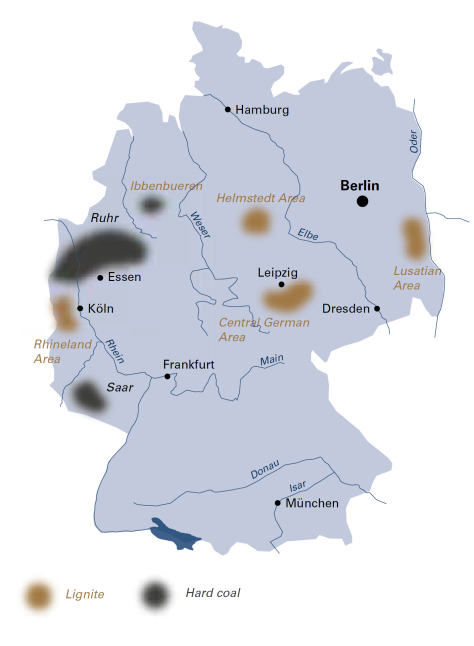
germany coal.jpg
source: Euracoal, 2015, Coal Deposits

Moreover, Germany’s target to put 1 million electric vehicles on the road is clearly going to be missed, since by the end of 2017 there were 131,000. The government’s strategy of aEUR 4000 subsidy per vehivle on green vehicles is all but wasted without a coherent and structured strategy to switch conventional vehicles with green vehicles.

The fact that Germany is set to miss its 2020 targets by 8% is terrible news. The OECD has called on Germany to take additional measures to make up for the loss, but nothing concrete has come out it., yet.

Therefore, although German renewables surpassing coal in electricity generation can be seen as a glimmer of hope in an otherwise grey backdrop, there are structural problems that stand in the way of achieving necessary reduction targets. And if Germany cannot achieve its own targets, then who can?

*Lignite, a.k.a brown coal, is a soft, brown, combustible, sedimentary rock formed from naturally compressed peat. It is considered the lowest rank of coal to its relatively low heat content and high moisture level, which means that it is very polluting and highly inefficient.  It has a carbon content around 60–70%.


Required Reading: Energiewende 2030: The Big Picture http://bit.ly/2FfCdIT 

🇺🇸Mr. Trump, Make The Grid Great Again!
One of President Trump’s most resounding battle cries during the election was the bold promise to invest in infrastructure. I am going to argue that Mr. Trump should focus on upgrading the US electric grid, most of which is +25 years old and some parts are even +40 years old.

100 years ago, when the original electric grid was built, it was not conceivable to imagine consumers choosing their distributed generation because an energy generator would burn a fossil fuel and create electricity, which would be transmitted to consumer’s homes and that was that.

But the advent of renewable energy and small, private wind and solar producers means that today’s grid is nearing the end of its useful life both physically and functionally. Today the world is much more mobile, fluid, and flexible, but the grid has not kept up. A smart grid is set to provide real benefits to all stakeholders, including consumers, utilities, and regulators.

For starters, it will bring environmental benefits: through efficient use of energy and existing capacity by using digital communications technology to detect and react to local changes in usage and it will give customers options and choices to change their behavior when it comes to the price and type of power they use, and when to use that energy resource efficiently.

Efficiency is optimized thanks to a smart grid because of a two-way power flow and the integration of energy storage capacity, which would allow consumers to take energy when they need it, and the feed it back (in the case of solar/ wind producers) into the grid when prices are higher or store it. However, today, the grid is not really equipped to handle neither reverse power flows nor storage.

The Grid: An Economy Enhancing Investment

Although Americans bemoan the disrepair of their dilapidated roads, transit, and airports in countless NYT editorial pieces, the Trump Administration must consider the unseen but increasingly crucial issue of reinventing the power grid.

While the electric utility sector may not be the most riveting, the U.S. smart grid expenditures forecasts at more than $3 billion in 2017 (PDF) and the global smart grid market expected to surpass $400 billion worldwide by 2020. Navigant Research, a clean tech consultancy, reports on worldwide revenues for smart grid IT (information technology) software and services, are expected to grow from $12.8 billion in 2017 to more than $21.4 billion in 2026.

The private sector is stepping up. Not only tech companies such as Oracle, IBM, SAS, Teradata, EMC, and SAP but also utility giants such as General Electric, Siemens, ABB, Schneider Electric, and Toshiba are getting involved in smart grid IT.

Moreover, with historically low-interest rates (for now) and the potential for infrastructure projects to deliver long-run economic returns, many believe infrastructure investment could kick-start the country’s slowish GDP growth. Yet in spite of a body of economic evidence which points to clear benefits derived from infrastructure investment, simply building more roads will not guarantee economic growth on its own, as the textbook examples: Japan and China indicate. This lesson is particularly important considering the falling returns from public investment in U.S. highways.

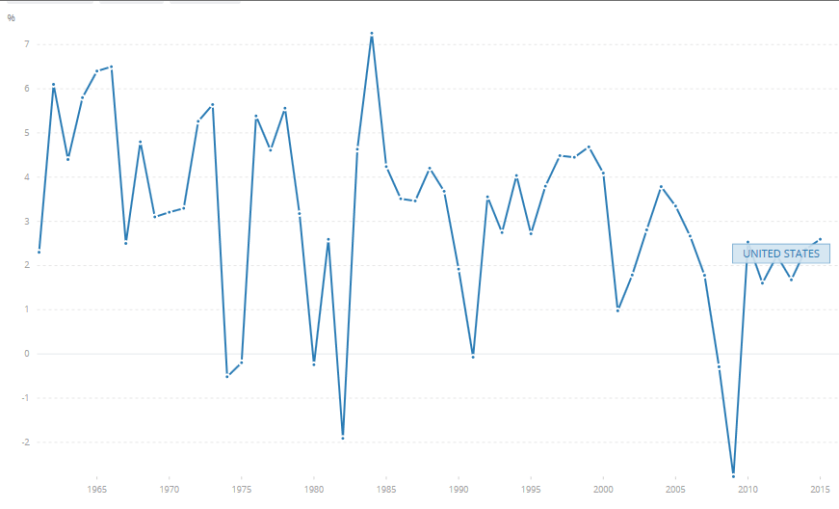
U.S GDP Growth % 1965-2015

USAGDP
World Bank Data, 2017

And this brings us to the grid: aiming investment at the grid would improve conditions for millions of people as well as address the needs of the private sector.

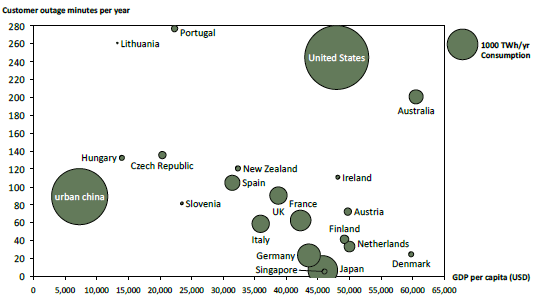
The average American endures 6+ hours of blackouts a year, which amounts to at least $150 billion for the public and private sector each year — about $500 for every man, woman, and child, – that is remarkably bad for a developed country. Power outages in the USA are mostly caused by the effect harsh weather on the aging grid. Heavy industry tends to be most affected by tiny outages, and this example from Saviva Research is painfully illustrative:

A robotic manufacturing facility owned by Toshiba experienced a 0.4-second outage, causing each robot to become asynchronous with the grid; thus short circuiting chips and circuits. Toshiba spent the next 3 months reprogramming each robot, leading to an estimated economic loss of $500m.


International Grid Reliability

Capture
Source: Saviva Research 2013

In the U.S, investments in the power grid lag behind Europe. Across the pond, since 2000, the U.K., Italy, Spain, France and Germany have spent a combined $150.3 billion on energy-efficiency programs, compared with $96.7 billion for the U.S, according to data by Bloomberg New Energy Finance. Moreover, according to a 2015 report by energy consultancy, the Rocky Mountain Institute the, the U.S.  needs about $2 trillion in grid upgrades by 2030.

The Smart Grid: A Strategic Economy-Enhancing Objective

Yet there is much that the government and the private sector should seek to unpack about consumer behavior, strategic implications, governance, and decision-making regarding the grid, before committing to such a massive investment. The incoming investments in the next decades offer a historically important opportunity to rethink how the whole system of power generation, transmission, and usage operates.

Here’s just one consideration: ownership. Future smart grids are likely to have multiple ownerships, which will most likely span across:

  1. The government: through publicly owned power and transmission lines;
  2. The private sector: independent wind farms developers and operators or utility-owned generators;
  3. Private citizens: owners of household-level battery backup systems or rooftop solar panels.

All it really means is that combining forces for a specific project makes it possible to focus each parties’ inherent assets in the way that best reduces their shared risks, and reduced risk means a lower cost of borrowing, and therefore: cheaper projects.

As J. Michael Barrett explains: If the federal or state government can reduce the investment risk of the project by providing seed capital, issuing tax-exempt bonds, and/or signing a power purchase agreement to buy energy for a guaranteed period of time, the private sector can then provide investment capital at more favorable rates because total project risk is reduced. When all the parties share the up-front construction costs (and risk), promote open access to usable land, and lock-in the commitment of long-term users.

Finally, the most plausible way forward is to invest in new technologies opposed to retrofitting them later, an educated, unideological clear-eyed strategic effort to make the most of these investments would ensure both improved operations improvements in resilience and adaptability across the board.

tl;dr: A functioning integrated electricity system is a basic public good, imperative to the wealth, safety, and wellbeing of any modern society. In the context of a rapidly evolving energy infrastructure landscape, taking a strategic stance during the development of the smart grid in the USA will determine how much value is captured and who will capture it.

Read more: here The Energy Infrastructure that the US Really Needs