And then there’s Dong

It’s hard to find a comparable energy company to Dong, the world’s largest developer and operator of offshore wind farms and European poster child for the transition from fossil fuels to green energy. Dong Energy is looking to sell a stake of approx. 17% which could value the company at €16bn.

Winds of Change: Move from black to green

Over decade ago, Dong Energy was one of Europe’s most coal-intensive utilities, providing thermal    electricity to its customers.It was also very active in offshore oil and gas exploration and extraction in Norway and Scotland.

In recent years,  the company embarked on an energy transition strategy and began selling off coal-fired assets and a part of its oil and gas business. For the past few years, their vision has been to reduce their energy generation from coal and transition to wind energy, becoming world’s biggest offshore wind company and are aiming to double their installed capacity from 3.0 gigawatts in 2016 to 6.5 gigawatts by 2020, equivalent to the annual electricity consumption of 16m people.

Dong CAPEX
Dong Investor Presentation, March 2016


According to their March 2016 Investor Presentation, towards 2020, they expect to allocate 80% of their capital investment to wind, 10-15% to biomass conversation and investments into the power grid. Finally, an ever shrinking 5-10% is targeted towards oil and gas.

Chief Executive Officer Henrik Poulsen, had this to say regarding their transition, “Fundamentally it is a strong portfolio. However, we see simply better risk-return opportunities in the renewables business, and therefore we are managing the oil and gas business for cash and reallocating that cash back into renewables.”

However, there is no denying that Denmark today is still reliant on oil, coal and gas. Make no mistake, was it not for the North Sea oil fields, the Danish success story might have looked very different. Since the 1990s, the oil and gas driven from the seabed north of Denmark have made the Danes quasi-self-sufficient with oil and gas, while simultaneously boosting the Danish economy. But the Danish energy story is changing, the investment strategy clearly trends towards RE and away from fossil fuels.

Coming Soon: June 9th, 2016 Dong Energy IPO

On Thursday, 9th June, Dong will look to sell a stake of as much as 17.4% in an IPO that may value the company as high as 106.5 billion kroner (€16 billion) for 200 to 255 kroner (€26-34) per share, thus making this the largest IPO this year.  Previously, Dong tried and stopped three past attempts to list from 2006 to 2008 due to market turmoil and other difficulties, but this time, they are marching ahead.

However, what’s special about Dong is that unlike any other large energy company, 75 % of its capital is already employed in wind power generation. While Dong has a small but active oil and gas business, it’s clear this is trending toward being a triviality in the overall core business mix.

Traditionally, investors interesting in exposure to RE through large companies typically have to invest in a traditional energy company whose diversification into clean energy is still small relative to their conventional power assets, but Dong has practically already transitioned. Moreover, the high quality domestic Danish power distribution network provides the stable revenue returns which are very reassuring to their investors. This signals that they can support investment in its core wind business.
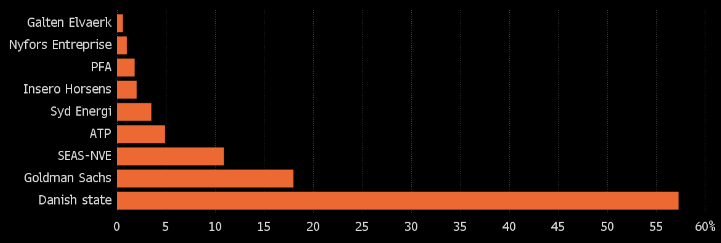
Owners of Dong Energy
Owners of Dong in %, Bloomberg


The Danish government now holds 59% of Dong and plans to maintain a holding of 51% after the IPO. Goldman Sachs with an 18% stake underscored its commitment to being a long-term partner in the future of the company.

Here are the take home messages that I think are valuable to keep in mind in the wake of their IPO:

1. Dong has access to very low-cost capital, especially in a macro backdrop where policy makers are incentivizing clean energy

2. Dong needs capital investment to ensure healthy returns to their shareholders

3. Dong’s objective, via this IPO is to share out the capital expenses through its partners

4. Dong’s distribution, generation and storage assets, can provide their grid resiliency in the cases of intermittency.
Renewable Energy and The Rise of the New Commodities

It’s no news to anyone that the commodities market has been a graveyard for investors in the last couple of years, with low prices and little sign of any positive catalysts. The global economic slowdown has affected goods such as steel, aluminium, copper and other commodities.

The 15-year commodity super cycle peaked circa 2008 and has experienced a trend of falling prices and stagnant/falling demand since. With lower market fundamentals and in China, commodities took another hit as demand fell off a cliff, with the expectation being that many commodities won’t recover for years as the world adjusts to a new structure, without heavy reliance on Chinese demand.

Demand for commodities is declining in part due to the deployment of renewable energies (RE). However, not all commodities are in a rut, some are actually benefiting from the rollout of RE as there are a few rising stars, that are making the world a *slightly greener* place.

The gold medal goes to:

Silver

solar-k8YG--621x414@LiveMint

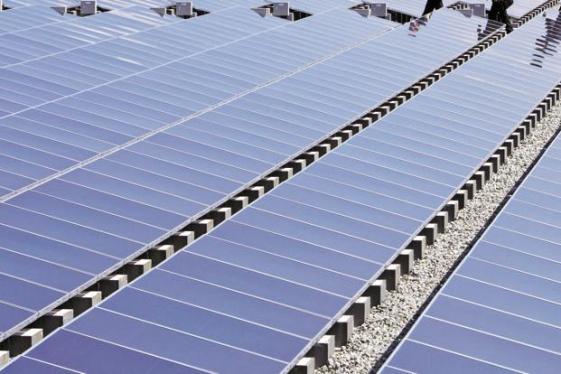
Silver is an extremely important mental for industrial fabrication, as it accounts for about 56% of world silver demand relative to gold, which only accounts for 8%. This is largely because silver is a crucial component of cell phones, monitors and tablets, plasma TVs, cables, precision instruments, and many other tech products.

Silver has become one of the best-performing commodities this year, fuelled by an increase in interest from hedge funds and Chinese traders after it fell to an uncommonly large discount to gold.

This is partly due to a significant increase in installations and investment in solar panels, which uses silver for its electrical conductivity. According to the Silver Institute, 70 million ounces of silver are projected for use in solar panels by 2016.  A very thin “paste” made from silver is applied to the front and back end of crystalline-silicon solar cells using highly efficient ink-jet technology (like the one in your printer), spraying silver nanometric conductive inks on solar cells, cutting solar cell energy costs even further.

Moreover, with the solar industry just accounting for 6% of overall physical silver demand, global solar capacity is growing at an average rate of 53% a year in the last decade, underscoring future growth potential, according to London-based Capital Economics’s Simona Gambarini. 

In any case, it is important to bear in mind that the price of gold and silver will continue to be impacted by changes to monetary policy. Since they have quite stable supply and demand, these commodities are more of a “pure play” on inflation than traditional industrial metals, energy, or agricultural commodities. They may also be influenced by technical factors and the economics of exchange-traded fund (ETF) buying and selling, which could introduce volatility to these markets in the future. 

Secondly:

Lithium a.k.a “White Gold” or “the new Gasoline”

Lithium is a soft, highly reactive metal which is quickly becoming an interesting alternative commodity investment. With uses ranging from heat-resistant glass and ceramics, alloys used in aircraft, and lubricating greases. Lithium is the key ingredient in many rechargeable batteries, plug-in cars and electric vehicles like the Nissan Leaf, Tesla, and hybrids. About 30% of lithium supplies are used in these rechargeable batteries.

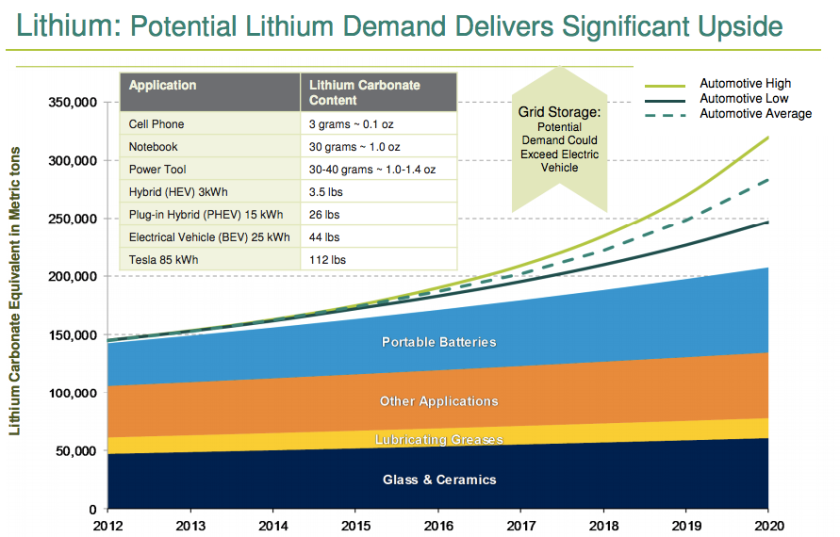
Analysts say demand will increase in the next 5 to 10 years as battery costs fall and electric vehicles and storage for grid power gain popularity. Today, the main lithium-ion battery makers are Samsung and LG of South Korea, Panasonic and Sony of Japan, and ATL of Hong Kong and BYD of China, whose government is scaling up the promotion of lithium-ion batteries and electric vehicles, with the biggest emphasis on city buses. Sales of “new energy” vehicles in China almost tripled in the first ten months of 2015 compared with the same period in 2014, to 171,000 (still it’s less than 1% of total vehicle sales).

Global Lithium Market Outlook @ Goldman Sachs HCID Conference, 3/16

Prices for lithium in China have risen 60% from about $7,000 a ton to over $20,000 recently, according to research by consultants CRU, while industry website Asian Metal says lithium carbonate, the compound used in batteries, has jumped by 76% in the past 12 months.

Still, it is not a relatively big business: lithium accounts for only about 5% of the materials in some car batteries, and for less than 10% of their cost. Worldwide sales of lithium salts are only about $1 billion a year. But it is a vital component of batteries that power everything from cars to smartphones, laptops and power tools. With demand for such high-density energy storage set to surge as vehicles become greener and electricity becomes cleaner.

Tesla, US electric car maker, will need to capture much of this growth as it will need 24,000 tonnes annually of lithium hydroxide, according to Benchmark Mineral Intelligence, out of a market last year of 50,000 tonnes. Moreover,  this year Tesla will begin production at its “Gigafactory” in Nevada, which it hopes will supply lithium-ion batteries for 500,000 cars a year within five years. J.B. Straubel, Tesla’s chief technical officer, says the firm wants to secure supplies of many battery materials, not just lithium.

Either way, larger automakers also have a growing demand for lithium. In a recent shift, Toyota has begun offering lithium-ion batteries in lieu of heavier less efficient nickel-metal hydride ones in its Prius hybrid.

Limited supply is another appealing factor that makes this metal a lucrative investment. 80% of the world’s lithium that is in Argentina, Chile and Bolivia (in the USA, Nevada is the only state that produces lithium), where the lithium is extracted from brine pools and refined.

Lithium is, for now, a tiny component of batteries, but  has the potential to shape the future of energy.

SunEdison went bust, it’s a big deal.

380x252
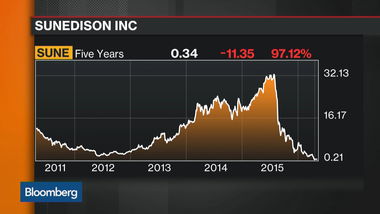
SunEdison stock price Bloomberg

SunEdison, the largest renewable-energy firm in the world went bust last week with $16.1 billion of debt, making it the biggest U.S. bankruptcy in more than a year. In a nutshell, they were victims of their own success, as they grew too fast and burned way too much borrowed money in the process.

Their bankruptcy says more about reckless investor strategy than about the solar industry as a whole.

Bad Strategy: Too much focus on Growth

In 2014, SunEdison created two subsidiaries, called “yieldcos”, to manage the projects that it built assets for. They are called TerraForm Power and TerraForm Global, both separate and publicly traded. The purpose of these “yieldcos”  was to purchase energy projects from SunEdison and other developers at lower capital costs and attract (read: lure) investors who expected reliable dividends based on long-term power contracts.

Unsurprisingly, not all of its their investments proved successful, which is the name of the game in the project development world, but SunEdison’s win to loss ratio was evidently lopsided. It ended up with a lot of money tied it up in projects at various stages of completion, which it needed to sell to realise the gains and pay back creditors.

In order to make sure that the yieldcos had projects to develop, SunEdison had to grow, quick. That took a lot of (borrowed) money.

Circling the Drain

Things turned sour in July 2015, after it announced that it would try to acquire Vivint, a residential solar roof-top company, at a 52% premium (!). That deal for residential assets deemed inferior to the commercial assets SunEdison usually bought (read: utility-scale projects) hinted to investors that SunEdison may not have as much liquidity as they thought. And investor appetite for the yieldco abruptly ended.

SunEdison vs. Creditors

Things are also ugly between SunEdisons first- and second-lien lenders who are fighting over who will give them the money they need to get out of the bankruptcy.

  • If the first-lien lenders win: they will fire sell all of SunEdison’s projects, which would be disastrous for the solar market because there would be many solar projects on the market, resulting in lower prices for these projects.
  • If the second-lien lenders win: they will attempt to get more value out of these projects, the first-lien lenders, which is better for the solar market.  There is a lot of value in the project pipeline, which ultimately comprises cash-generating assets not tied to the continued existence of SunEdison, and it would be a shame if they were sold below value. But this will take time since investors will take time to do the due diligence to value these projects before buying them.

This does not bode well

SunEdison started off as having an investment portfolio of utility scale projects backed by governments, to investing in residential solar roof-top backed by private investors, therefore substantially increasing risk. Their free cash flow was negative and their net debt skyrocketed and eventually led to the bankruptcy. But SunEdison is not unique in that regard. Solarcity, SunPower and First Solar have managed a develop-and-sell business profitably over the past three years and are engaging in similar growth strategies all in plain view.