How to Handle a Climate Change Denier

Preamble: I would like to point out that I truly prefer not to engage in these types of discussions (read: I’m over it), because the sources of information that are available to me, are available to everyone else. I also do not consider it my duty to educate every Tom, Dick, and Henry on climate change. However, in light of recent developments, we will probably be encountering a more energized brand of deniers, so here is a non-exhaustive list of answers I took from Robert Henson’s Rough Guide to Climate Change.

Since the days of Roger Revelle, the pioneering oceanographer whose body of work was instrumental for our understanding of the role of greenhouse gas emissions in our atmosphere, deniers developed certain criticisms that are still popular today. I believe that these arguments will keep on cropping up for as long as there is a “debate” on climate change, so it’s best that we equip ourselves with appropriate answers.

Taken to the extreme, anti climate change arguments can be summed up in the following quote:

The atmosphere isn’t warming; and if it is, then it’s due to natural variation; and even if it’s not due to natural variation, then the amount of warming is insignificant; and if it becomes significant, then the benefits will outweigh the problems; and even if they don’t, technology will come to the rescue;  and even if it doesn’t, we shouldn’t wreck the economy to fix the problem when many parts of the science are uncertain.”

toles-washington-post-2006
Toles 2006, Washington Post 

 “But the atmosphere isn’t warming….”


According to an ongoing temperature analysis conducted by scientists at NASA’s Goddard Institute for Space Studies (GISS), the average global temperature on Earth has increased by a mean of about 0.8° Celsius (1.4° Fahrenheit) since 1880. Two-thirds of the warming has occurred since 1975, at a rate of roughly 0.15-0.20°C per decade.

This arguement, has seeminly been put to rest, yet deniers seem to resist it, possibly because they do no think that a global mean warming of 0.8°C is a big deal. Here is a more vivd statistical example of what that means:
giphy
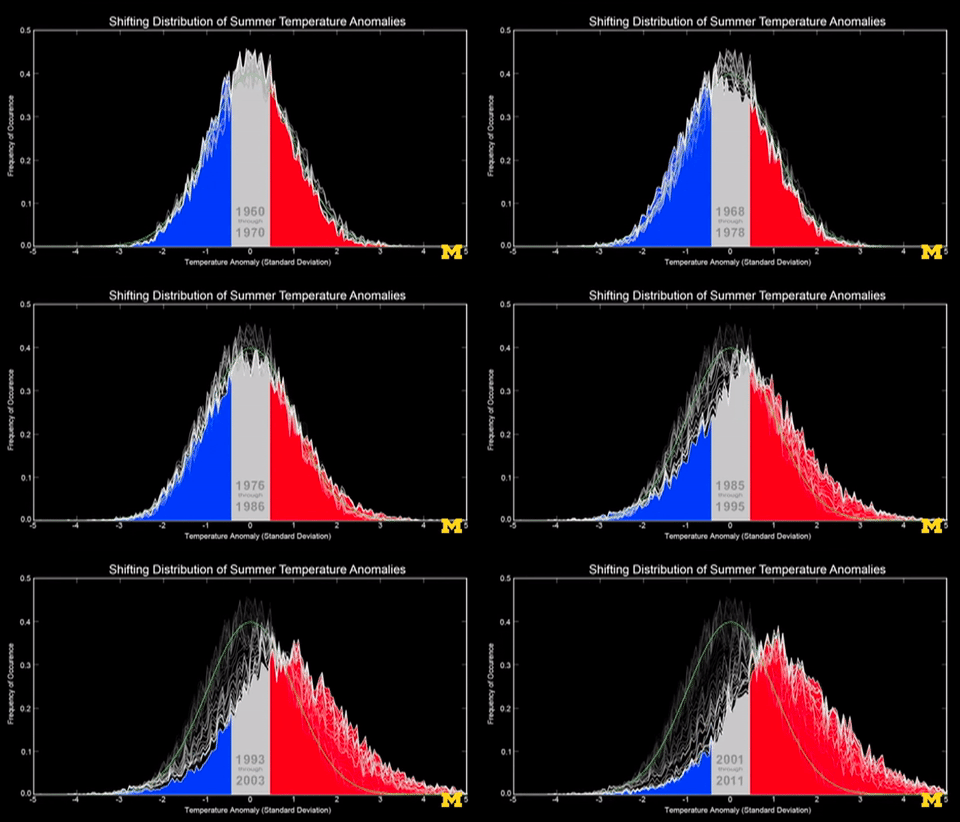
Dr. Arun Majumdar’s presentation, Michigan State University

This is a bell curve mapping distribution of temperature anomalies over 60 years. To the left are temperatures colder than average and to the right are temperatures hotter than average. The mean is shifting and the distribution is broadening rightwards. The right tail of the distribution is reaching 4 and 5 sigma, which are probabilities that were unheard of decades ago. The anomalies occurring at 4 and 5 sigma are (were) rare massive heatwaves, storms, and floods, which are becoming more common then ever.

“Okay, but I still went skiing this winter…”


The weather and the climate are two different things. The difference between weather and climate is a measure of time. Weather is what conditions of the atmosphere are over a short period of time, and climate is how the atmosphere “behaves” over relatively long periods of time. We talk about climate change in terms of years, decades, and centuries. The weather is forecast 5 0r 10 days ahead, but the climate is studied across long periods of time to look for trends or cycles of variability, such as the changes in wind patterns, ocean surface temperatures, and precipitation. Snow in skiing locations isn’t proof that climate change is not happening.

The warming is due to natural variation…


This is a very common argument, the denier does not argue against the existence of climate change, generously admitting the climate has *always* changed, but they do not believe that humans are responsible for it.

The IPCC has concluded that the warming of the last century, especially from the 1970s, falls outside the bounds of natural variability.

carbon-budget-exhibits_3-e1488189073538.png
Variation of Co2 in atmosphere, from 800000BC to today, NOAA NCDC

Let’s walk down memory lane and look at what the IPCC has been saying to us for 26 years. And keep in mind that the IPCC reports are the most comprehensive, global, and peer-reviewed studies on climate change ever written by anyone, bringing together the work of over 800 scientists, more than 450 lead authors from more than 130 countries, and more than 2,500 expert reviewers. In short, the IPCC reports are humanity’s best attempt to date at getting the science right.

Over the last 800,000 years, Earth’s climate has been cooler than today on average, with a natural cycle between ice ages and warmer interglacial periods. Over the last 10,000 years (since the end of the last ice age) we have lived in a relatively warm period with stable CO2 concentration. Humanity has flourished during this period. Some regional changes have occurred – long-term droughts have taken place in Africa and North America, and the Asian monsoon has changed frequency and intensity – but these have not been part of a consistent global pattern.

The rate of CO2 accumulation due to our emissions in the last 200 years looks very unusual in this context (see chart above). Atmospheric concentrations are now well outside the 800,000-year natural cycle and temperatures would be expected to rise as a result.

Moreover, the IPCC in 1995, in its second assessment report included a sentence that hit the headlines worldwide:

“The balance of evidence suggests a discernible human influence on global climate”

By 2001, IPPC’s third report was even clearer:

“There is an new and stronger evidence that most of the warming observed over the last 50 years is attributable to human activities.”

By 2007, in it’s fourth report, IPCC spoke more strongly still:

“Human induced warming of the climate system is widespread”

In 2013, in the 5th Assessment Report, they stated,

“It is extremely likely that human influence on climate caused more than half of the observed increase in global average surface temperature from 1951 to 2010”

Human activity has led to atmospheric concentrations of carbon dioxide, methane and nitrous oxide that are unprecedented in at least the last 800,000 years.

There is, therefore, a clear distinction to be made between what is “natural variability” and what is our contribution.

“The amount of warming is insignificant…


screen-shot-2017-01-18-at-12-28-35-pm

The European Geosciences Union published a study in April 2016 that examined the impact of a 1.5°C vs. a 2.0°C (bear in mind we are at 0.8°C now, without the slightest chance of slowing down) temperature increase by the end of the century. It found that the jump from 1.5 – 2°C, a third more of an increase, raises the impact by about that same fraction, on most of the natural phenomena the study covered. Heat waves would last around a third longer, rain storms would be about a third more intense, the increase in sea level would be that much higher and the percentage of tropical coral reefs at risk of severe degradation would be roughly that much greater.

But in other cases, that extra increase in temperature makes things ever more dire. At 1.5°C, the study found that tropical coral reefs stand a chance of adapting and reversing a portion of their die-off in the last half of the century. But at 2°C, the chance of recovery disappears. Tropical corals are virtually wiped out by the turn of the century.

With a 1.5°C rise in temperature, the Mediterranean area is forecast to have about 9% less fresh water available. At 2°C, that water deficit nearly doubles. So does the decrease in wheat and maize harvest in the tropics.

Bottom line: It may look small but it’s a huge deal.

“The benefits will outweigh the problems”


When people talk of alleged benefits of climate change, they are usually talking about agriculture. The argument says that the increased concentrations of CO2 will give a boost to crop harvests leading to larger yields.

This is laughable

Climate change will slow the global yield growth because high temperatures result in shorter growing seasons. Shifting rainfall patterns can also reduce crop yields. Climate trends are already believed to be diminishing global yields of maize and wheat. These symptoms will only worsen as temperatures and extreme weather events become more common. If climate change is allowed to reach a point where the biophysical threshold is exceeded, as would be the case on current emission trajectories, then crop failure will become normal. Also, the severest risks are faced by countries with high existing poverty and dependence on agriculture for livelihoods. Even at “low” levels of warming, vulnerable areas will suffer serious impacts.

  • Sub-Saharan Africa, according to the World Economic Forum, at 1.5°C warming by 2030 would bring about a 40% loss in maize cropping areas;
  • South East Asia, in a 2°C would experience unprecedented heat extremes in 60%-70% of their areas.

Agricultural productivity is at risk, not only in developing countries but also in breadbasket regions such as North and South America, the Black Sea and Australia.

Moreover, in October 2015, a study published in Nature estimated that the world could see a 23% drop in global economic output by 2100 due to a changing climate, compared to a world in which climate change is not taking place. The coauthor of the study had this to say,

“Historically, people have considered a 20% decline in global GDP to be a black swan: a low-probability catastrophe – Instead, we’re finding it’s more like the middle-of-the-road forecast.”

Technology will come to the rescue…”

Deniers who make this case seemingly acknowledge climate change, yet they are optimistic believers in technology being the be-all end-all and that geo-engineering will save us from the clutches of global warming.  There are two things I find problematic about this approach:

  1. I think this argument is akin to the “We almost discovered nuclear fusion- we’re only 20 years away!” argument, which stipulates that the nuclear fusion is at any given point in time 20 years away. It takes into account that we have not developed the appropriate technologies to “save” us from climate change, and when we do, there is still a maddening lag between the innovation and deployment. Not to mention the fact we still have not identified which technologies can do the greatest good in the shortest time so we cannot fly blindly in a vague hope that tech will rescue us;
  2. Such an approach fights the “symptoms” of climate change, not the cause of it, meaning that it entrenches our extremely wasteful and inefficient ways that have brought on climate change in the first place.

None of this is to say that I do not believe that technology will play a pivotal role in our transition, of course, it will! But we cannot afford to rely entirely on waiting for carbon capture and storage and the likes to become a deployable and scalable economic reality.

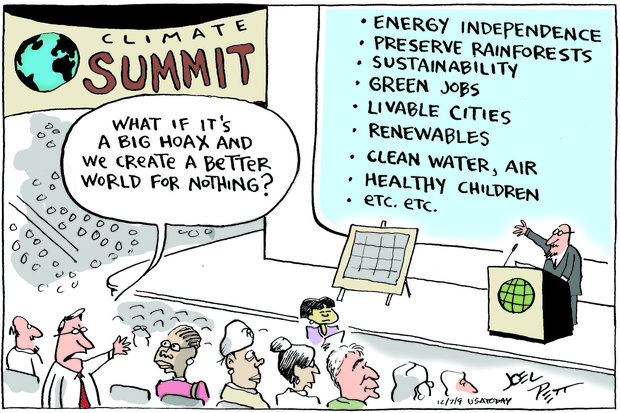
“We shouldn’t wreck the economy to fix the problem when it’s still uncertain!”
6930c533b5f4fb2d43c4c27d18de62d1

When you really get down do it, people will just tell you what their ultimate bottom-line is. If we don’t know with absolute confidence how much you warmer and what the local and regional impact will be perhaps we’d better not committing ourselves to costly reductions in greenhouse gas emissions.

I have written a post on the employment benefits tied to jobs in the renewable energy sector, and there are a plethora of studies pointing to the huge costs of climate change inaction, amongst these, a new study by scholars from the LSE, published last year in Nature Climate Change, offers a daunting scenario.

They estimate that a business-as-usual emissions path would lead to expected warming of 2.5 degrees C by 2100. Under that scenario, banks, pension funds, and investors could sacrifice up to $2.5 trillion in value of stocks, bonds, and other financial assets. The worst-case scenario, with a 1% chance of occurring, would put $24 trillion (about 17 % of global financial assets) at risk.  This is but one of the scenarios that have been studied, that point to the huge costs of inaction.

Climate change can affect the economy in myriad ways; including the extent to which people can perform their jobs, how productive they are at work, and the effects of shifting temperatures and precipitation patterns on things like agricultural yields or manufacturing processes. These factors help determine our “economic output” — all the goods and services produced by an economy.

In spite of the fact that there is disagreement on how much exactly economies will be affected, we know the cost of inaction will be immense. With the information at our disposal, it would be foolish and dangerous to assume that reducing emissions will cost more than coping with a changing climate.

Good luck with your “debate” and let me know how it goes.

🔥What is tax equity and why should I care?

There is quite a bit of confusion regarding what tax equity is for renewable energy and how it can be taken advantage of. This is largely because tax equity structures are ubiquitously understood to be complicated, meaning many firms just don’t bother with them. That’s a mistake. Tax equity can be a powerful incentive for developing RE in the USA.

Companies that have managed navigate the system have been able to reap the benefits of tax equity structures, but new entrants can be deterred, therefore bypassing potential benefits.

What is Tax Equity?

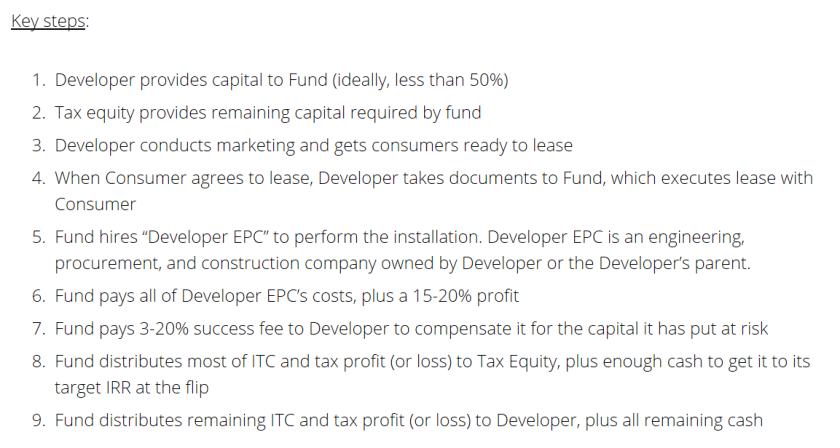
Tax equity is where renewable energy and tax policy intersect.  Basically, tax equity is a creative and complex way to split the benefits of installing and producing RE electricity from their corresponding tax benefits.

Tax credits, however, can only be used by clean energy developers who are profitable enough to pay larger amounts of taxes. Because of this, many smaller players, who are not very profitable cannot reap the benefits of tax credits. Hence, they must find an investment partner with enough income to be able to reap credible benefits from tax credits.

Installing renewable energy is subsidized by a tax credit. This means that a solar project developer/company/host wants to have the benefits of solar electricity production (via decreased utility bills)  but does not the tax liability to use the tax credits, so it passes those credits to an investor who in return puts up capital to pay for the solar project. The objective is to reduce its own tax bill by receiving the tax deduction.  Tax equity financing is primarily provided by large banks, insurers or big corporations which provide upfront investment in exchange for tax credits associated with the development of (usually) solar energy projects.

Example:

Take solar developer start-up, Sunny Ltd., who wants to develop a large solar PV project. The cost of the project would be $1m. Although such an investment in RE carries corresponding tax credits, Sunny Ltd. is currently not profitable enough to take advantage of them, so they decide to rope in a Tax Equity Investor. The Tax Equity Investor, represented by Capital One Bank, wants to apply the tax credits to their own corporate tax bill.

So Capital One Bank can put up, say 40% of the solar project financing, used as equity (the remaining 60% hypothetically will come from debt).

So if the bank puts up $400K in equity, they could hypothetically reduce their tax bill by a certain amount over the course of a contract.

State of the Market

According to specialized law firm Chadbourne & Park, the market is steadily increasing. The U.S wind and solar markets in 2015 saw $11.5 billion in new tax equity deals, up from $10.1b from the year before. According to John Eber, head of energy investments at J.P Morgan, of that 11.5b, $6.4b was secured in the wind marketplace for projects totaling 5,700 megawatts capacity. There was three main sponsors int he winds tax equity investors that completed deals totaling $1b each (47% of tax equity raised in 2015). 

In the solar residential tax equity market, about $2.6b was raised by three leading residential solar companies, accounting for 90% of the residential market, (up from $1.9b in 2014). Eber went on to say that distributed generation and utility-scale solar marketplace accounted for an additional $2.5b in tax equity deals. Eber says there are about 20 active tax equity investors in the wind marketplace and 27 in solar, with some crossover, and of the 20 active investors in wind, 17 entered into deals in 2015.

The small number of players is attributed, in part to the complex nature of tax equity and the associated costs and in part due to the fact that tax equity investors must have very large tax liabilities, to justify such operations.

But be that as it may, it is still a huge increase if you consider that after the financial crisis, the number of Tax Equity Investors collapsed from 14 providers to just 5 (Jacoby, University of Pennsylvania Law Review), since in order to take advantage of tax equity, you need to have huge tax liabilities and the after 2008 fewer companies had the necessary tax liabilities to make tax credits attractive.

Before we have a look at a few tax equity structures used, bear in mind who the stakeholders are:

Tax Equity Agreements usually have three stakeholders, although sometimes the developer and host are the same:

  1. A Developer (ex. a solar PV installer like SolarCity or FirstSolar ) who identifies a potential solar project and decides to undertake the costs and risks of engineering, procurement, installation, and commissioning;
  2. The Solar Host who is usually either a residential or commercial building owner, and is interested in the benefits of solar power;
  3. A Tax Equity Investor who usually is an institution like a bank or a corporation like Google, that has to have two things:
    1. high tax liabilities, or at least high enough to make a tax credit attractive
    2. the liquidity necessary to undertake the development of a solar project.

The Tax Equity Investor has to agree to finance and own the project for a number of years and in return for undertaking the construction and ownership costs of the solar project the company will receive the corresponding tax deductions.

The Tax Equity Investor is the defacto owner of the physical solar panels, while the benefits go to the host, and once the Tax Equity Investor reaps in the desired returns brought by the tax credits associated with the solar projects they return ownership to the developer.

Tax credit structures can vary quite a bit, but here are the two most common types:

The Partnership Flip

As you can probably imagine, a Tax Equity Investor does not necessarily want to hang on to the solar panels for the entire life of the project- why would they? Enter The Partnership Flip. This is where the ownership of a project is owned by both developer and tax equity investor but in varying degrees. 

partnershipflip

capture22
Source: Woodlawn Associates


The Tax Equity Investor and the developed enter into a partnership in which the have joint ownership of the solar project. Say, at the beginning of the project the ownership the Tax Equity Investor will hold 90% while and the developer will own 10%. Progressively, as the Tax Equity Investor begins to reap the rewards of the tax credits, the ownership of the project will begin to “flip”, whereby the Tax Equity Investor will own 60% and the Developer 40%…then 50%-50% until it is 10%-90% for the Developer.

Sale – Leaseback Agreement

screen-shot-2017-02-05-at-22-19-16
Source: Woodlawn Associates

This agreement sees the solar developer selling the project to the tax equity investor and then the tax equity investor leases it back to the solar developer. It’s actually simpler than a partnership, because all the tax benefits pass directly to the tax equity invest right away, whereas with a partnership, years pass before the Tax Equity Investor reaps all the benefits.

The Developer will install, operate and maintain the project and a Host will agree to purchase the power generated from the project, via a PPA.

The Investor keeps all the tax benefits and receives payment (cash) in the form of rent from the solar developer. The developer’s revenue from the PPA is used to make rental payments under the lease. The developer has a taxable gain on the sale of the project to the extent that the value of the project exceed the cost to build it. Indeed, the developer will usually have the option, exercisable at the end of the lease period, to buy the project from the investor at its fair market value.

The developer and the tax equity investor are like to two passengers in a car, when the car hits a bump, they are both impacted.

With solar and wind installations predicted to increase, 2017 will definitely see more tax equity deals for renewable energy, but what remains to be seen is if investors will be able to keep and meet the capital requirements of the industry.


Cover Photo: Ian Waldie/ Getty Images

☀️Sunny Saudi is Going Solar

There is a famous quote by Former Saudi Oil Minister from 1962-86 Sheik Zaik Yamani that people in (renewable) energy never tire of throwing out there,

“The Stone Age did not end for lack of stone, and the Oil Age will end long before the world runs out of oil” – Sheik Zaik Yamani

Sheik Yamani was no wishful thinker.

Energy shifts happen, in part because of poles pulling in different directions, not necessarily because of a lack of supply. There is plenty of oil in the ground and it is being extracted more cheaply and efficiently than ever before, yet the current environment is propelling Saudi Arabia (&Co)  into the opposite direction. 

Today, when someone mentions Saudi Arabia’s energy mix, what usually comes to mind is crude, crude and more crude, but come a few years this will change radically. With the nosedive that the oil price took in the last few years, Saudi Arabia is launching a massive renewable energy plan to try to replace some, if not all, of their energy needs.

The Plan

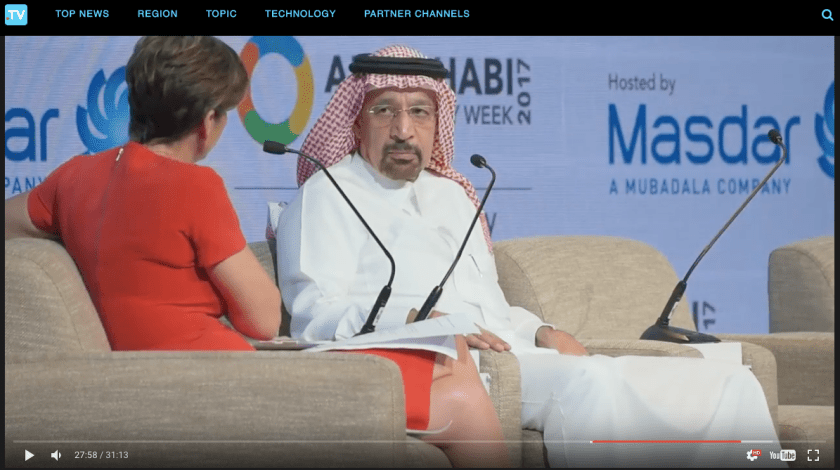
Newly appointed energy Minister Khalid al-Falih, a graduate of Texas A&M University and Chairman of Aramco, intends to launch an ambitious renewable energy program and is currently soliciting tendering bids. The program, which is to be officially launched “very soon” is expected to involve an investment of between $30 billion and $50 billion by 2023, he said at a press conference in Dubai.

solar-panel-tv
Minister al-Falih interviewed by CNN’s Becky Anderson @ ADSW 2017, Solarpv.tv

The plan involves the development of almost 10 gigawatts of renewable energy by 2023, starting with wind and solar plants across the sun-soaked northwestern desert. The effort has the potential to replace the equivalent of 80k barrels of oil a day now burned for electricity generation.

According to Bloomberg, bidders seeking to qualify to build 700 megawatts of wind and solar power plants should submit documents by March 20, and those selected will be announced by April 10, Saudi Arabia’s energy ministry said Monday in an e-mailed statement. Qualified bidders will be able to present their offers for the projects starting on April 17 through July.

The Kingdom intends to require all investors to invest in the local supply chain of goods and services, so as to render themselves more competitive.

🇸🇦The Kingdom’s Electricity Needs

Relying heavily on hydrocarbons as feedstock for the electricity sector, Saudi Arabia is by far the largest user of crude oil for power generation in the world. Oil accounts for two-thirds of the input into electricity generation, with natural gas providing most of the remaining portion, according to the Joint Organizations Data Initiative (JODI). During the prohibitively hot summer months, consumption of electricity increases as domestic demand for air conditioning rises. The Kingdom has recognized that this is both highly inefficient, expensive and unsustainable.

main
EIA, JODI

Saudi Arabia used an average of 0.7 million bbl/d of crude oil for power generation during the summers from 2009 to 2013, which is massive. To put this into perspective, that same period, Iraq and Kuwait, the next two largest users of crude oil for power generation in the Middle East, each averaged roughly 0.08 million bbl/d of crude burn. At the same time, net electricity consumption in Saudi Arabia has more than doubled since 2000.

Shifting the energy mix towards renewable energy would bring about several key advantages:

  1. Local Emissions Reductions: more on that later;
  2. Economics: The Kingdom has seen two years of budget deficit, and is looking at a $53b deficit moving into 2017. Stubbornly low oil prices have forced austerity measures on a country that is not associated with belt- tightening measures. In the context of the 2018 Aramco IPO prospected to raise $100b, it is clear that the economic tide is shifting. With the Kingdom’s main sources of income: oil exports, decreasing due to a number of economic factors, this leaves less for exporting and therefore less revenue. By shifting to renewables, they aim to free the crude currently being consumed domestically so they can export it, thus generating more revenue;
  3. Diversification: diversifying their investment portfolio away from oil is recognition that an economy based on the export of crude is, as demonstrated, highly vulnerable to prices drops and other external shocks.
brent
Price Oil Drop from 2014- Feb 2017

Saudi Arabia has boosted output for years to sustain export income while also satisfying domestic demand. Demand for refined fuels such as gasoline has doubled since 2003, according to JODI. Moreover, Saudi Arabia, the UAE, Qatar, Oman, and Bahrain have significantly reduced or eliminated fuel subsidies over the past year to limit government spending because of low oil prices. Brent crude is trading at $55 a barrel today compared to $112 per barrel between 2011 and 2014.

Domestic demand for oil increased by about 24,000 barrels a day in the first five months of 2016, the slowest growth rate for that period since at least 2010, the first year according to JODI.

1x-1
Bloomberg, 2016

Mario Maratheftis, chief economist at Standard Chartered Plc. said, according to Bloomberg, “Renewable energy is not a luxury anymore – If domestic use continues like this, eventually the Saudis won’t have spare oil to export.’’

Without alternative power sources, including gas and renewables, the kingdom would be forced to increase the amount of crude it burns, diverting it from exports. That can reach as high as 900,000 barrels a day during the kingdom’s summer months, according to data from the JODI.

Saudi Arabia has already taken steps to substitute natural gas for oil in power plants, a change that’s had “immense” impact on the crude burn, OPEC said in its Monthly Oil Market Report released in January. The use of crude for domestic power has fallen by nearly 1/3rd since the Wasit gas plant began operations in March 2016, according to the OPEC report.

300,000 Barrels

Saudi Aramco will bring online the similar-sized Fadhili gas project in the country’s east by the end of the decade. That gas project along with the renewable projects, planned for completion by 2023 could save about 300k barrels of oil from being burnt for power, according to estimates based on IEA and OPEC data.

According to Fabio Scacciavillani, chief economist at the Oman Investment Fund, “Alternative energies are a key factor in the economic transformation, this region has a great competitive advantage in low-cost energy production and that will continue with renewables. That will create a big advantage particularly in energy-intensive industries.’’

On top of that, the Saudis want to build nuclear reactors, a less ambitious program that would see 2.8 GW of new electric capacity.

The end goal is to generate 30% of the Kingdom’s electricity from renewable sources by 2030, with the remainder to come from natural gas and a small portion from nuclear.

Deputy Crown Prince Mohammed, at the forefront of promoting reforms and development in his country, said, “I think by 2020, if oil stops, we can survive…We need it, we need it, but I think in 2020 we can live without oil.”

The Tide is Turning to an Energy  Transition

It goes without saying that the primary reason the Saudis are shifting to renewables is economics rather than emissions, yet we can still predict some emission reductions.

It is clear that the Kingdom does not expect oil prices to increase above $100 like it was a few years ago. They know that the days when they would squeeze massive economic rent out of oil have passed. Their long-term objective is to ensure the future competitiveness of their oil in a global environment where paradoxically, fossil fuels are abundant and renewable energy has a higher penetration, while still decarbonizing their energy sector.

This takes me back to Sheik Yamani’s prediction. It is not so much that the Kingdom is physically running out of oil to sell as much as the energy environment is changing. The supply is outpacing demand and oil is just not as profitable as it was. The hammer blows of energy efficiency, renewable energy, and global economic trends are forcing a transition to better options.

Sheik Yamani’s prediction is coming to life.


Trend #1: Investment in Renewable Energy 2015

Old critiques, die hard. For the longest time, renewable energy (RE) has been viewed as too expensive and un-scalable, as a luxury energy source, that will not be deployed in developing countries. As a matter of fact, how many times did you hear the criticism, that by diverting investment away from so-called “cheap” fossil fuel energy, we would be depriving developing countries of their right to develop?

The numbers quantifying investments in RE are in! It should be no surprise that RE investment is increasing significantly and the developing world, especially China, is leading the way.

The findings of the United Nations Environment Programme (UNEP) Global Trends in Renewable Energy Investments 2016 confirmed that RE set new records in 2015 for dollar investments, the amount of new capacity added and the relative importance of developing countries in the context of that growth.

Record-breaking uptrend in Renewable Energy Investments

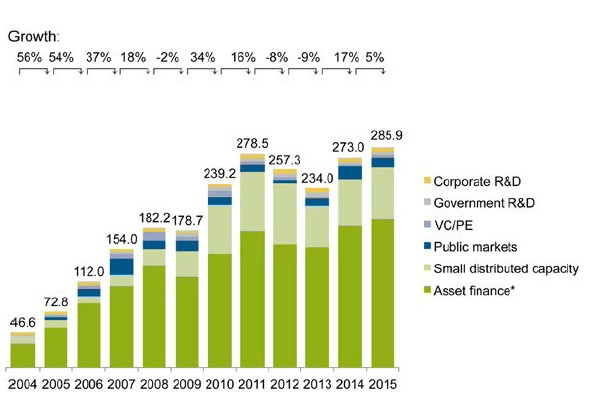
Global investment in RE rose 5% to $285.9 billion from 2014 to 2015, breaking the previous record of $278.5 billion reached in 2011 (FYI that’s double the dollar allocations to new coal and gas generation, which was an estimated $130 billion in 2015) when the famous ‘green stimulus’ programs in German and Italian were in full throttle. The figure below shows that the 2015 investment increased sixfold since 2004 and that investment in RE has not been below $230b since 2010.

GLOBAL NEW INVESTMENT IN RE BY ASSET CLASS, 2004-2015, $BN

global-investment-in-re-asset-class-2004-2015-b
Source: UNEP, Bloomberg New Energy Finance

*Asset finance volume adjusts for re-invested equity. Total values include estimates for undisclosed deals.

Over the course of the 12 years shown in the chart, the cumulative RE investment has reached $2.3 trillion.

Moreover, in 2015 some 134GW of RE excluding large hydro were commissioned, equivalent to some 53.6% of all power generation capacity completed in that year – and this is worth mentioning because it is the first time it has represented a majority. Of the renewables total, wind accounted for 62GW installed, and solar photovoltaics 56GW, highest ever figure and sharply up from their 2014 additions of 49GW and 45GW respectively.

Developing Countries Leading the Way

The investment which led to record-breaking levels came from China, which lifted its investment by 17% to $102.9 billion, about 36% of the global total. In the Middle East and Africa, investment was up a total of 58% at $12.5 billion, helped by project development in especially in South Africa and Morocco; and in India, up 22% at $10.2 billion.

More significantly, 2015 was the first year in which investment in RE (excluding large hydro) was higher in developing economies than in developed countries. The figure below shows that the developing world invested $156 billion last year, some 19% up on 2014 and a remarkable 17 times the equivalent figure for 2004, of $9 billion.

INVESTMENT IN RE: DEVELOPED/ DEVELOPING COUNTRIES, 2004-2015, $BN

global-new-investment-in-re-developed-vs-developing
source: UNEP, Bloomberg

The key contributors to this shift from developed to developing are the big three: China, India, and Brazil, who saw an investment rise of 16% to $120.2 billion

A large part of the record-breaking investment in developing countries took place in China. Indeed China has been the single biggest reason for the strong increasing trend for the developing world as a whole since 2004. In spite of low market fundamentals and much talk of decreased investment in RE, China has been a key contributor to these figures. China invested $102.9 billion in 2015, up 17%, representing well over a third of the global total.

Likewise, India enjoyed a second successive year of increasing investment, breaching the $10 billion for the first time since 2011.

Other developing countries, excluding the big three, lifted their investment by 30% last year to an all-time high of $36 billion, some 12x their 2004 investment, the biggest players are:

  • South Africa also deserves an honorable mention as it’s RE investment is up 329% at $4.5 billion significantly ramping up their solar PV, in the context of their auction program. In June last year, the government in Pretoria launched a tender for an additional 1.8GW for its renewables program. One of the signal deals later in the year was the financing in September of the 100MW Redstone solar thermal project for an estimated $756m, helped by loans from the World Bank’s International Finance Corporation and Overseas Private Investment Corporation of the US;
  • Mexico saw a 105% increase at $4 billion, aided by investment from the development bank Nafin for 9 wind projects. Moreover, Mexico is emerging as an important location for bond issues to back renewable energy projects. In November last year, National Financiera issued $500 million worth of five-year bonds to contribute towards the development of nine wind farms with a total capacity of 1.6GW;
  • Chile saw an increase of 151% higher at $3.4 billion, thanks to a sizable uptrend in solar project financings;
  • Morocco, Turkey, and Uruguay also saw investment increases in excess of the $1 billion milestone in 2015.

Developed world downward trend (mostly)

In the developed world, however, we are witnessing a downward trend quite consistently, since 2011, when it peaked at $191 billion, some 47% higher than the 2015 outturn. Developed countries invested $130 billion in 2015, down 8% and their lowest figure since 2009. This decline is due to two major factors:

  1. because of the US, where firstly; there was a rush of investment in 2011 as projects and companies tried to catch the Treasury grant and Federal Loan Guarantee programmes before they expired and secondly, the US Supreme Court’s decision in February 2016 to allow all legal objections to the Environmental Protection Agency’s Clean Power Plan to be heard before it can be implemented may be deterring investment in 2016.
  2. but much more to do with Europe, where allocations fell by 60% between 2011 and 2015. That big drop was caused by a mix of factors including retroactive cuts in support for existing projects in Spain, Romania and several other countries, an economic downturn in southern Europe that made electricity bills more of a political hot potato, the cut of government subsidies aimed at incentivizing RE in Germany and Italy, and the big fall in the cost of PV panels over recent years.Italy, in particular, saw renewable energy investment of just under $1 billion, down 21% on 2014 and far below the peak of $31.7 billion seen during the PV boom of 2011.

Retroactive cuts to feed-in tariffs really weaken support for solar energy investments. Spain, scene of particularly painful retroactive revenue cuts imposed by the government during the 2011-14 period, and the end of all support for new projects, saw investments of just $573 million in 2014. This was slightly up on the previous year but miles below the $23.6 billion peak of 2008.

But it’s not all bad in Europe, especially since the UK has not seen a significant slowdown in RE investments in recent years, and is actually pushing in the opposite direction. Moreover, in spite of the fact that offshore wind in the North Sea has seen massive investments amounting to $17b, Europe’s aggregate RE investment is still in decline.

Renewable Energy and The Rise of the New Commodities

It’s no news to anyone that the commodities market has been a graveyard for investors in the last couple of years, with low prices and little sign of any positive catalysts. The global economic slowdown has affected goods such as steel, aluminium, copper and other commodities.

The 15-year commodity super cycle peaked circa 2008 and has experienced a trend of falling prices and stagnant/falling demand since. With lower market fundamentals and in China, commodities took another hit as demand fell off a cliff, with the expectation being that many commodities won’t recover for years as the world adjusts to a new structure, without heavy reliance on Chinese demand.

Demand for commodities is declining in part due to the deployment of renewable energies (RE). However, not all commodities are in a rut, some are actually benefiting from the rollout of RE as there are a few rising stars, that are making the world a *slightly greener* place.

The gold medal goes to:

Silver

solar-k8YG--621x414@LiveMint

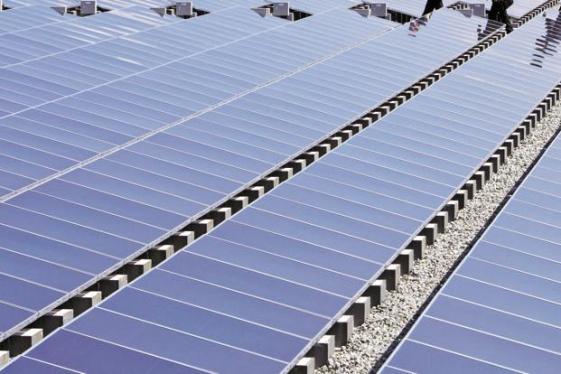
Silver is an extremely important mental for industrial fabrication, as it accounts for about 56% of world silver demand relative to gold, which only accounts for 8%. This is largely because silver is a crucial component of cell phones, monitors and tablets, plasma TVs, cables, precision instruments, and many other tech products.

Silver has become one of the best-performing commodities this year, fuelled by an increase in interest from hedge funds and Chinese traders after it fell to an uncommonly large discount to gold.

This is partly due to a significant increase in installations and investment in solar panels, which uses silver for its electrical conductivity. According to the Silver Institute, 70 million ounces of silver are projected for use in solar panels by 2016.  A very thin “paste” made from silver is applied to the front and back end of crystalline-silicon solar cells using highly efficient ink-jet technology (like the one in your printer), spraying silver nanometric conductive inks on solar cells, cutting solar cell energy costs even further.

Moreover, with the solar industry just accounting for 6% of overall physical silver demand, global solar capacity is growing at an average rate of 53% a year in the last decade, underscoring future growth potential, according to London-based Capital Economics’s Simona Gambarini. 

In any case, it is important to bear in mind that the price of gold and silver will continue to be impacted by changes to monetary policy. Since they have quite stable supply and demand, these commodities are more of a “pure play” on inflation than traditional industrial metals, energy, or agricultural commodities. They may also be influenced by technical factors and the economics of exchange-traded fund (ETF) buying and selling, which could introduce volatility to these markets in the future. 

Secondly:

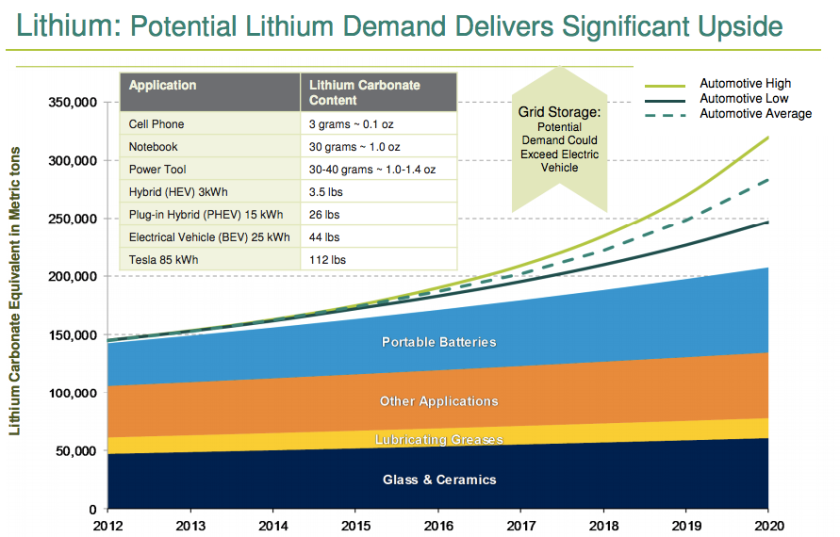
Lithium a.k.a “White Gold” or “the new Gasoline”

Lithium is a soft, highly reactive metal which is quickly becoming an interesting alternative commodity investment. With uses ranging from heat-resistant glass and ceramics, alloys used in aircraft, and lubricating greases. Lithium is the key ingredient in many rechargeable batteries, plug-in cars and electric vehicles like the Nissan Leaf, Tesla, and hybrids. About 30% of lithium supplies are used in these rechargeable batteries.

Analysts say demand will increase in the next 5 to 10 years as battery costs fall and electric vehicles and storage for grid power gain popularity. Today, the main lithium-ion battery makers are Samsung and LG of South Korea, Panasonic and Sony of Japan, and ATL of Hong Kong and BYD of China, whose government is scaling up the promotion of lithium-ion batteries and electric vehicles, with the biggest emphasis on city buses. Sales of “new energy” vehicles in China almost tripled in the first ten months of 2015 compared with the same period in 2014, to 171,000 (still it’s less than 1% of total vehicle sales).

Global Lithium Market Outlook @ Goldman Sachs HCID Conference, 3/16

Prices for lithium in China have risen 60% from about $7,000 a ton to over $20,000 recently, according to research by consultants CRU, while industry website Asian Metal says lithium carbonate, the compound used in batteries, has jumped by 76% in the past 12 months.

Still, it is not a relatively big business: lithium accounts for only about 5% of the materials in some car batteries, and for less than 10% of their cost. Worldwide sales of lithium salts are only about $1 billion a year. But it is a vital component of batteries that power everything from cars to smartphones, laptops and power tools. With demand for such high-density energy storage set to surge as vehicles become greener and electricity becomes cleaner.

Tesla, US electric car maker, will need to capture much of this growth as it will need 24,000 tonnes annually of lithium hydroxide, according to Benchmark Mineral Intelligence, out of a market last year of 50,000 tonnes. Moreover,  this year Tesla will begin production at its “Gigafactory” in Nevada, which it hopes will supply lithium-ion batteries for 500,000 cars a year within five years. J.B. Straubel, Tesla’s chief technical officer, says the firm wants to secure supplies of many battery materials, not just lithium.

Either way, larger automakers also have a growing demand for lithium. In a recent shift, Toyota has begun offering lithium-ion batteries in lieu of heavier less efficient nickel-metal hydride ones in its Prius hybrid.

Limited supply is another appealing factor that makes this metal a lucrative investment. 80% of the world’s lithium that is in Argentina, Chile and Bolivia (in the USA, Nevada is the only state that produces lithium), where the lithium is extracted from brine pools and refined.

Lithium is, for now, a tiny component of batteries, but  has the potential to shape the future of energy.

SunEdison went bust, it’s a big deal.

380x252
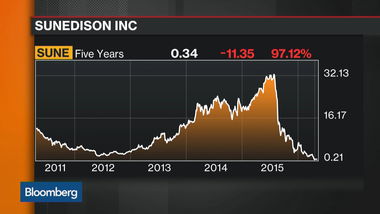
SunEdison stock price Bloomberg

SunEdison, the largest renewable-energy firm in the world went bust last week with $16.1 billion of debt, making it the biggest U.S. bankruptcy in more than a year. In a nutshell, they were victims of their own success, as they grew too fast and burned way too much borrowed money in the process.

Their bankruptcy says more about reckless investor strategy than about the solar industry as a whole.

Bad Strategy: Too much focus on Growth

In 2014, SunEdison created two subsidiaries, called “yieldcos”, to manage the projects that it built assets for. They are called TerraForm Power and TerraForm Global, both separate and publicly traded. The purpose of these “yieldcos”  was to purchase energy projects from SunEdison and other developers at lower capital costs and attract (read: lure) investors who expected reliable dividends based on long-term power contracts.

Unsurprisingly, not all of its their investments proved successful, which is the name of the game in the project development world, but SunEdison’s win to loss ratio was evidently lopsided. It ended up with a lot of money tied it up in projects at various stages of completion, which it needed to sell to realise the gains and pay back creditors.

In order to make sure that the yieldcos had projects to develop, SunEdison had to grow, quick. That took a lot of (borrowed) money.

Circling the Drain

Things turned sour in July 2015, after it announced that it would try to acquire Vivint, a residential solar roof-top company, at a 52% premium (!). That deal for residential assets deemed inferior to the commercial assets SunEdison usually bought (read: utility-scale projects) hinted to investors that SunEdison may not have as much liquidity as they thought. And investor appetite for the yieldco abruptly ended.

SunEdison vs. Creditors

Things are also ugly between SunEdisons first- and second-lien lenders who are fighting over who will give them the money they need to get out of the bankruptcy.

  • If the first-lien lenders win: they will fire sell all of SunEdison’s projects, which would be disastrous for the solar market because there would be many solar projects on the market, resulting in lower prices for these projects.
  • If the second-lien lenders win: they will attempt to get more value out of these projects, the first-lien lenders, which is better for the solar market.  There is a lot of value in the project pipeline, which ultimately comprises cash-generating assets not tied to the continued existence of SunEdison, and it would be a shame if they were sold below value. But this will take time since investors will take time to do the due diligence to value these projects before buying them.

This does not bode well

SunEdison started off as having an investment portfolio of utility scale projects backed by governments, to investing in residential solar roof-top backed by private investors, therefore substantially increasing risk. Their free cash flow was negative and their net debt skyrocketed and eventually led to the bankruptcy. But SunEdison is not unique in that regard. Solarcity, SunPower and First Solar have managed a develop-and-sell business profitably over the past three years and are engaging in similar growth strategies all in plain view.