The Employer of the Year is….(Renewable Energy)

I have heard it said:

“The [traditional] energy system employs millions of people!”

“Renewables will create massive job losses!”

“Fossil fuels may not be good for the planet, but at least they employ millions!”

and last but not least:

“Green jobs are the miracle that never happened”

Far be it for me to assess whether green jobs were ever meant to be “miraculous”, but I will say that “green jobs”, defined by the US Bureau of Labor Statistics (BLS) as either “jobs in business that produce goods and services that benefit the environment or conserve natural resources” or as “jobs in which workers’ duties involve making their company’s production process more environmentally friendly or use fewer natural resources”, are increasing at unprecedented levels.
capture
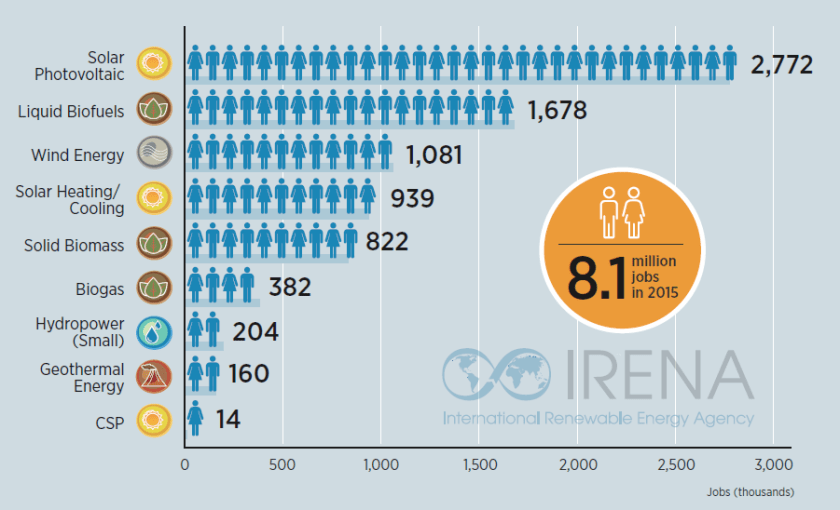
Number of Jobs in Renewably Energy, Irena, 2016

The International Renewable Energy Agency (IRENA) published their annual report detailing employment in the IRENA’s 2016 report, (link here – to learn more about their methodology, I suggest you check it out) estimated total employment in the RE sector to amount to 8.1m people. Adnan Amin, director-general or IRENA commented on the report stating, “The continued job growth in the renewable energy sector is significant because it is in contrast to trends across the energy sector. The increase is being driven by declining RE technology costs and enabling policy frameworks.”

Most of these jobs are in China, Brazil, USA, India, Japan, Germany, Indonesia, France, Bangladesh, and Colombia.

capture1
Renewable Energy Jobs by Country, Irena, 2016

Jobs in renewable energy increased by 18% from the estimates reported two years ago with a steady regional shift towards Asia.

In 2014, the Solar PV emerged as the largest employer in the energy sector accounting for 2.8 million jobs, an 11% increase from last year, and two-thirds of which were in China. Solar PV grew the most in USA and Japan while decreasing in Europe. Indeed, the global aggregate production of solar panels keeps increasing and pushing further into Asia, with lower costs of installations driving that accelerated growth. Global wind employment crossed the 1m job mark, fueled mainly by deployment in China, Germany, the USA, and Brazil.

Although, it’s good news (mostly) all around, the winner this year is:

🇨🇳Gold Medal: China

China has firmed up to be the leading renewable energy job market in the world, with 3.5m people employed. Domestic deployment and rising solar PV demand solidified that growth at 4% to 1.4m jobs. Chinese Solar PV jobs are focused on manufacturing (with 80%) following by installations and operations. The largest solar water heating technology industry and market are in China since they provide for both domestic and international demand. Half of the global wind jobs are in China, and more than 70% of those are in manufacturing.

Moreover, China is also is a leader in hydropower employment, as they add 75 GW of new projects between 2014-2017. Construction and installation account for 70% of the countries large hydropower employment.

Indeed, China has and installed 65 gigawatts more in renewable energy in 2015, shift the labor force from oil and gas, towards renewables. Now, China employs 3.5m people in renewable energy and only 2.6m in oil and gas, that 35% more people in RE than in oil and gas (coal excluded).

capture
Source: Irena, taken from Bloomberg

Although the lion’s share of the RE labor force is employed in manufacturing, this growth rate is likely to begin to contract, in spite of growth in technological deployment due to:

  1. market consolidation in favor of large suppliers/ manufacturers resulting in economies of scale;
  2. automation of process will make manufacturing more efficient, which will make it less labor intensive.

The runner up is:

🇺🇸Silver Medal: United States

Renewable energy jobs in the USA have increased at a historic pace, owing to large consumer demand and constantly declining prices of RE, especially solar. The Solar Foundation’s National Solar Jobs Census 2016 found that the solar industry accounts for 2% of all jobs created in the US over the past year, with the absolute number of solar jobs increasing in 44 of the 50 states. As of November 2016, there were 260k solar workers employed in America, “representing a growth rate of 24.5% relative to November 2015” according to the report.

This is great news all round since it signals that solar is receiving investments and creating thousands of high-skilled jobs, ultimately driving growth, strengthening businesses and reducing emissions (pollution) in cities. Moreover, wind recovered from a policy-induced slump in new installations and saw wind jobs rise by 43%.

Moreover, according to the annual U.S Energy Employment Report, published January 2017, more people are employed in solar power last year than in coal, gas, and oil combined. They report found that 43% of the total electric power generation workforce was employed in solar energy while fossil fuels accounted for a mere 22%. The report goes on to say that the US solar installation sector alone employs more than the domestic coal industry. Since 2014, solar installation has created more jobs than oil and gas pipeline construction and crude petroleum and natural gas extraction combined.

sourcesirenausbofstatisticsbloomberg
Source: Department of Energy, BLS, taken from Bloomberg

The electricity mix in the USA is shifting decisively in the direction of renewable energy, driven by the transition from coal-fired power plants, to gas and now, steadily in low-carbon energy sources.

🇧🇷Bronze Medal: Brazil

Employment in RE in Brazil is concentrated in the cultivation and production of biofuels. I am aware that there is a huge debate regarding whether of not biofuels production (especially from sugarcane..etc) is considered a real “green job” but that is an argument for another day, but today, I will be counting them as green jobs.

With 821,000 jobs, Brazil continues to have the largest liquid biofuel workforce by far. Reductions of about 45,000 jobs in the country’s ethanol industry (due to the ongoing mechanization of sugarcane harvesting, even as production rose) were only partially offset by job growth in biodiesel. Biofuel production, especially in a developing country tends to be labor intensive, on account of inefficiency and poor access to technology, which have explained why those working in biofuels in Brazil are just under 1m people.

However, Brazils wind energy sector is growing rapidly, which power capacity expanding from 1 GW in 2010 to 6 GW in 2014. Moreover, while there was one mere wind power equipment manufacturer, there were ten in 2007, indicating the sector is maturing. Most of these jobs are in construction and manufacturing.

Brazil’s solar heating market is expanding strongly in the past decade. In 2013, there were an estimated 41k people employed, between manufacturing and installation.

🇪🇺Consolation prize: European Union

Owing to a mélange of adverse policy conditions, regulatory uncertainty and a sharp decrease in investment, the number of RE jobs in the EU declined from 1.25m to 1.2m. Germany, however, is the euro leader in terms of job, with 271k jobs in RE. This is more than double the runner-up, France, which is ahead of UK, Italy, and Spain. RE employment in France fell by 4%- primarily because solar PV installations dwindled by 45%). We are likely to see a shift, due to Denmark and the UK’s ambitious off-shore wind plans which will (if they go through with them) likely create expansion in the near future. The EU has been suffering consistent defeats against China in terms of lower manufacturing competitiveness and a weaker installations market, leading to a net decrease in solar jobs… for now.

“But Jobs!”

Growing awareness of the harmful effects of GHGs on the environment and on our health, coupled with consumer preferences are pushing investment into renewable energy, leading to logical increases in employment in RE.  Conversely, the tumbling price of oil has led to a slowdown of industry expansion (too expensive deep off-shore, arctic projects, and unconventional drilling) and the corresponding reduction in capital expenditure and operational expenditure has had significant effects on the oil and gas labor force.

I do not think that the “But what about the jobs!” argument to be complete without merit. But a growing trend and body of evidence point to the fact that potential job losses in the traditional energy sector can be compensated by green jobs, however, an argument runs in parallel with this reasoning. And that is the fact that energy jobs are geographically and personally specific, meaning you can’t plug a worker out of an oil field in Texas and jettison them into a solar PV role easily. Re-skilling, training, and compensation for job losses are some of the conversations we will have to have in the next few years.

Nevertheless, the writing is on the wall.


Cover picture: Alex Wong, Getty Images

Trend #1: Investment in Renewable Energy 2015

Old critiques, die hard. For the longest time, renewable energy (RE) has been viewed as too expensive and un-scalable, as a luxury energy source, that will not be deployed in developing countries. As a matter of fact, how many times did you hear the criticism, that by diverting investment away from so-called “cheap” fossil fuel energy, we would be depriving developing countries of their right to develop?

The numbers quantifying investments in RE are in! It should be no surprise that RE investment is increasing significantly and the developing world, especially China, is leading the way.

The findings of the United Nations Environment Programme (UNEP) Global Trends in Renewable Energy Investments 2016 confirmed that RE set new records in 2015 for dollar investments, the amount of new capacity added and the relative importance of developing countries in the context of that growth.

Record-breaking uptrend in Renewable Energy Investments

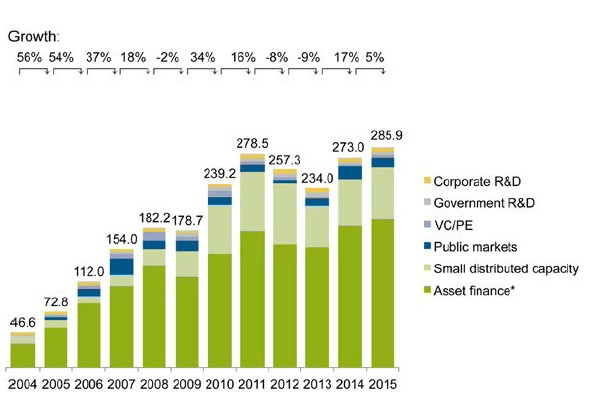
Global investment in RE rose 5% to $285.9 billion from 2014 to 2015, breaking the previous record of $278.5 billion reached in 2011 (FYI that’s double the dollar allocations to new coal and gas generation, which was an estimated $130 billion in 2015) when the famous ‘green stimulus’ programs in German and Italian were in full throttle. The figure below shows that the 2015 investment increased sixfold since 2004 and that investment in RE has not been below $230b since 2010.

GLOBAL NEW INVESTMENT IN RE BY ASSET CLASS, 2004-2015, $BN

global-investment-in-re-asset-class-2004-2015-b
Source: UNEP, Bloomberg New Energy Finance

*Asset finance volume adjusts for re-invested equity. Total values include estimates for undisclosed deals.

Over the course of the 12 years shown in the chart, the cumulative RE investment has reached $2.3 trillion.

Moreover, in 2015 some 134GW of RE excluding large hydro were commissioned, equivalent to some 53.6% of all power generation capacity completed in that year – and this is worth mentioning because it is the first time it has represented a majority. Of the renewables total, wind accounted for 62GW installed, and solar photovoltaics 56GW, highest ever figure and sharply up from their 2014 additions of 49GW and 45GW respectively.

Developing Countries Leading the Way

The investment which led to record-breaking levels came from China, which lifted its investment by 17% to $102.9 billion, about 36% of the global total. In the Middle East and Africa, investment was up a total of 58% at $12.5 billion, helped by project development in especially in South Africa and Morocco; and in India, up 22% at $10.2 billion.

More significantly, 2015 was the first year in which investment in RE (excluding large hydro) was higher in developing economies than in developed countries. The figure below shows that the developing world invested $156 billion last year, some 19% up on 2014 and a remarkable 17 times the equivalent figure for 2004, of $9 billion.

INVESTMENT IN RE: DEVELOPED/ DEVELOPING COUNTRIES, 2004-2015, $BN

global-new-investment-in-re-developed-vs-developing
source: UNEP, Bloomberg

The key contributors to this shift from developed to developing are the big three: China, India, and Brazil, who saw an investment rise of 16% to $120.2 billion

A large part of the record-breaking investment in developing countries took place in China. Indeed China has been the single biggest reason for the strong increasing trend for the developing world as a whole since 2004. In spite of low market fundamentals and much talk of decreased investment in RE, China has been a key contributor to these figures. China invested $102.9 billion in 2015, up 17%, representing well over a third of the global total.

Likewise, India enjoyed a second successive year of increasing investment, breaching the $10 billion for the first time since 2011.

Other developing countries, excluding the big three, lifted their investment by 30% last year to an all-time high of $36 billion, some 12x their 2004 investment, the biggest players are:

  • South Africa also deserves an honorable mention as it’s RE investment is up 329% at $4.5 billion significantly ramping up their solar PV, in the context of their auction program. In June last year, the government in Pretoria launched a tender for an additional 1.8GW for its renewables program. One of the signal deals later in the year was the financing in September of the 100MW Redstone solar thermal project for an estimated $756m, helped by loans from the World Bank’s International Finance Corporation and Overseas Private Investment Corporation of the US;
  • Mexico saw a 105% increase at $4 billion, aided by investment from the development bank Nafin for 9 wind projects. Moreover, Mexico is emerging as an important location for bond issues to back renewable energy projects. In November last year, National Financiera issued $500 million worth of five-year bonds to contribute towards the development of nine wind farms with a total capacity of 1.6GW;
  • Chile saw an increase of 151% higher at $3.4 billion, thanks to a sizable uptrend in solar project financings;
  • Morocco, Turkey, and Uruguay also saw investment increases in excess of the $1 billion milestone in 2015.

Developed world downward trend (mostly)

In the developed world, however, we are witnessing a downward trend quite consistently, since 2011, when it peaked at $191 billion, some 47% higher than the 2015 outturn. Developed countries invested $130 billion in 2015, down 8% and their lowest figure since 2009. This decline is due to two major factors:

  1. because of the US, where firstly; there was a rush of investment in 2011 as projects and companies tried to catch the Treasury grant and Federal Loan Guarantee programmes before they expired and secondly, the US Supreme Court’s decision in February 2016 to allow all legal objections to the Environmental Protection Agency’s Clean Power Plan to be heard before it can be implemented may be deterring investment in 2016.
  2. but much more to do with Europe, where allocations fell by 60% between 2011 and 2015. That big drop was caused by a mix of factors including retroactive cuts in support for existing projects in Spain, Romania and several other countries, an economic downturn in southern Europe that made electricity bills more of a political hot potato, the cut of government subsidies aimed at incentivizing RE in Germany and Italy, and the big fall in the cost of PV panels over recent years.Italy, in particular, saw renewable energy investment of just under $1 billion, down 21% on 2014 and far below the peak of $31.7 billion seen during the PV boom of 2011.

Retroactive cuts to feed-in tariffs really weaken support for solar energy investments. Spain, scene of particularly painful retroactive revenue cuts imposed by the government during the 2011-14 period, and the end of all support for new projects, saw investments of just $573 million in 2014. This was slightly up on the previous year but miles below the $23.6 billion peak of 2008.

But it’s not all bad in Europe, especially since the UK has not seen a significant slowdown in RE investments in recent years, and is actually pushing in the opposite direction. Moreover, in spite of the fact that offshore wind in the North Sea has seen massive investments amounting to $17b, Europe’s aggregate RE investment is still in decline.

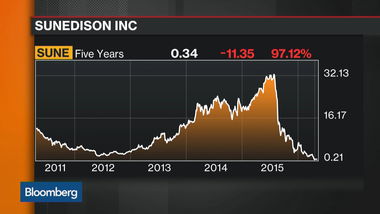
SunEdison went bust, it’s a big deal.

380x252
SunEdison stock price Bloomberg

SunEdison, the largest renewable-energy firm in the world went bust last week with $16.1 billion of debt, making it the biggest U.S. bankruptcy in more than a year. In a nutshell, they were victims of their own success, as they grew too fast and burned way too much borrowed money in the process.

Their bankruptcy says more about reckless investor strategy than about the solar industry as a whole.

Bad Strategy: Too much focus on Growth

In 2014, SunEdison created two subsidiaries, called “yieldcos”, to manage the projects that it built assets for. They are called TerraForm Power and TerraForm Global, both separate and publicly traded. The purpose of these “yieldcos”  was to purchase energy projects from SunEdison and other developers at lower capital costs and attract (read: lure) investors who expected reliable dividends based on long-term power contracts.

Unsurprisingly, not all of its their investments proved successful, which is the name of the game in the project development world, but SunEdison’s win to loss ratio was evidently lopsided. It ended up with a lot of money tied it up in projects at various stages of completion, which it needed to sell to realise the gains and pay back creditors.

In order to make sure that the yieldcos had projects to develop, SunEdison had to grow, quick. That took a lot of (borrowed) money.

Circling the Drain

Things turned sour in July 2015, after it announced that it would try to acquire Vivint, a residential solar roof-top company, at a 52% premium (!). That deal for residential assets deemed inferior to the commercial assets SunEdison usually bought (read: utility-scale projects) hinted to investors that SunEdison may not have as much liquidity as they thought. And investor appetite for the yieldco abruptly ended.

SunEdison vs. Creditors

Things are also ugly between SunEdisons first- and second-lien lenders who are fighting over who will give them the money they need to get out of the bankruptcy.

  • If the first-lien lenders win: they will fire sell all of SunEdison’s projects, which would be disastrous for the solar market because there would be many solar projects on the market, resulting in lower prices for these projects.
  • If the second-lien lenders win: they will attempt to get more value out of these projects, the first-lien lenders, which is better for the solar market.  There is a lot of value in the project pipeline, which ultimately comprises cash-generating assets not tied to the continued existence of SunEdison, and it would be a shame if they were sold below value. But this will take time since investors will take time to do the due diligence to value these projects before buying them.

This does not bode well

SunEdison started off as having an investment portfolio of utility scale projects backed by governments, to investing in residential solar roof-top backed by private investors, therefore substantially increasing risk. Their free cash flow was negative and their net debt skyrocketed and eventually led to the bankruptcy. But SunEdison is not unique in that regard. Solarcity, SunPower and First Solar have managed a develop-and-sell business profitably over the past three years and are engaging in similar growth strategies all in plain view.