🇺🇸Mr. Trump, Make The Grid Great Again!

One of President Trump’s most resounding battle cries during the election was the bold promise to invest in infrastructure. I am going to argue that Mr. Trump should focus on upgrading the US electric grid, most of which is +25 years old and some parts are even +40 years old.

100 years ago, when the original electric grid was built, it was not conceivable to imagine consumers choosing their distributed generation because an energy generator would burn a fossil fuel and create electricity, which would be transmitted to consumer’s homes and that was that.

But the advent of renewable energy and small, private wind and solar producers means that today’s grid is nearing the end of its useful life both physically and functionally. Today the world is much more mobile, fluid, and flexible, but the grid has not kept up. A smart grid is set to provide real benefits to all stakeholders, including consumers, utilities, and regulators.

For starters, it will bring environmental benefits: through efficient use of energy and existing capacity by using digital communications technology to detect and react to local changes in usage and it will give customers options and choices to change their behavior when it comes to the price and type of power they use, and when to use that energy resource efficiently.

Efficiency is optimized thanks to a smart grid because of a two-way power flow and the integration of energy storage capacity, which would allow consumers to take energy when they need it, and the feed it back (in the case of solar/ wind producers) into the grid when prices are higher or store it. However, today, the grid is not really equipped to handle neither reverse power flows nor storage.

The Grid: An Economy Enhancing Investment

Although Americans bemoan the disrepair of their dilapidated roads, transit, and airports in countless NYT editorial pieces, the Trump Administration must consider the unseen but increasingly crucial issue of reinventing the power grid.

While the electric utility sector may not be the most riveting, the U.S. smart grid expenditures forecasts at more than $3 billion in 2017 (PDF) and the global smart grid market expected to surpass $400 billion worldwide by 2020. Navigant Research, a clean tech consultancy, reports on worldwide revenues for smart grid IT (information technology) software and services, are expected to grow from $12.8 billion in 2017 to more than $21.4 billion in 2026.

The private sector is stepping up. Not only tech companies such as Oracle, IBM, SAS, Teradata, EMC, and SAP but also utility giants such as General Electric, Siemens, ABB, Schneider Electric, and Toshiba are getting involved in smart grid IT.

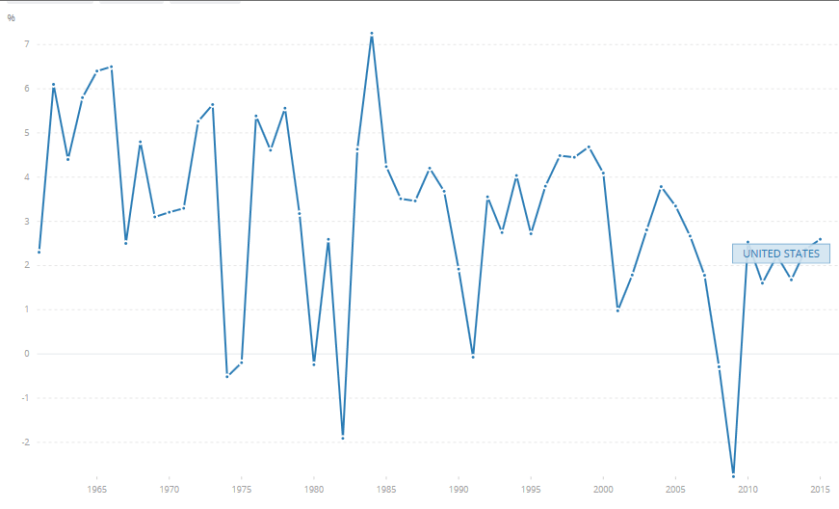
Moreover, with historically low-interest rates (for now) and the potential for infrastructure projects to deliver long-run economic returns, many believe infrastructure investment could kick-start the country’s slowish GDP growth. Yet in spite of a body of economic evidence which points to clear benefits derived from infrastructure investment, simply building more roads will not guarantee economic growth on its own, as the textbook examples: Japan and China indicate. This lesson is particularly important considering the falling returns from public investment in U.S. highways.

U.S GDP Growth % 1965-2015
USAGDP
World Bank Data, 2017

And this brings us to the grid: aiming investment at the grid would improve conditions for millions of people as well as address the needs of the private sector.

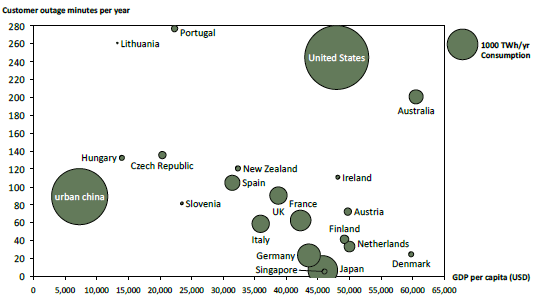
The average American endures 6+ hours of blackouts a year, which amounts to at least $150 billion for the public and private sector each year — about $500 for every man, woman, and child, – that is remarkably bad for a developed country. Power outages in the USA are mostly caused by the effect harsh weather on the aging grid. Heavy industry tends to be most affected by tiny outages, and this example from Saviva Research is painfully illustrative:

A robotic manufacturing facility owned by Toshiba experienced a 0.4-second outage, causing each robot to become asynchronous with the grid; thus short circuiting chips and circuits. Toshiba spent the next 3 months reprogramming each robot, leading to an estimated economic loss of $500m.


International Grid Reliability
Capture
Source: Saviva Research 2013

In the U.S, investments in the power grid lag behind Europe. Across the pond, since 2000, the U.K., Italy, Spain, France and Germany have spent a combined $150.3 billion on energy-efficiency programs, compared with $96.7 billion for the U.S, according to data by Bloomberg New Energy Finance. Moreover, according to a 2015 report by energy consultancy, the Rocky Mountain Institute the, the U.S.  needs about $2 trillion in grid upgrades by 2030.

The Smart Grid: A Strategic Economy-Enhancing Objective

Yet there is much that the government and the private sector should seek to unpack about consumer behavior, strategic implications, governance, and decision-making regarding the grid, before committing to such a massive investment. The incoming investments in the next decades offer a historically important opportunity to rethink how the whole system of power generation, transmission, and usage operates.

Here’s just one consideration: ownership. Future smart grids are likely to have multiple ownerships, which will most likely span across:

  1. The government: through publicly owned power and transmission lines;
  2. The private sector: independent wind farms developers and operators or utility-owned generators;
  3. Private citizens: owners of household-level battery backup systems or rooftop solar panels.

All it really means is that combining forces for a specific project makes it possible to focus each parties’ inherent assets in the way that best reduces their shared risks, and reduced risk means a lower cost of borrowing, and therefore: cheaper projects.

As J. Michael Barrett explains: If the federal or state government can reduce the investment risk of the project by providing seed capital, issuing tax-exempt bonds, and/or signing a power purchase agreement to buy energy for a guaranteed period of time, the private sector can then provide investment capital at more favorable rates because total project risk is reduced. When all the parties share the up-front construction costs (and risk), promote open access to usable land, and lock-in the commitment of long-term users.

Finally, the most plausible way forward is to invest in new technologies opposed to retrofitting them later, an educated, unideological clear-eyed strategic effort to make the most of these investments would ensure both improved operations improvements in resilience and adaptability across the board.

tl;dr: A functioning integrated electricity system is a basic public good, imperative to the wealth, safety, and wellbeing of any modern society. In the context of a rapidly evolving energy infrastructure landscape, taking a strategic stance during the development of the smart grid in the USA will determine how much value is captured and who will capture it.

Read more: here The Energy Infrastructure that the US Really Needs

What’s (not) happening with Algae Biofuels

Next generation algae biofuel is a fuel derived from growing synthetic (genetically modified) algae and decomposing it to extract oils that can be used to substitute conventional petroleum. It is (was?) envisioned principally as a fuel for vehicles and aircraft and therefore as a possible replacement for gasoline/kerosene.

Before we go any further, any discussion on the viability of algae biofuels needs to be framed along these points:

  • Can biofuels from algae compete on price with fossil-derived petroleum?
  • Is it carbon neutral, emitting only CO2that it absorbs first during growth?
  • Can it scale?
  • Does algae biofuel yield substantial energy relative to the energy inputs involved in its production? (Energy Return on Energy Invested)

Basically, you’re asking yourself: is it better than what’s already out there?
The answer is: Nope, at least for now.

The Value Proposition of Algae Biofuels

Potentially the most promising of biofuel technologies, algae set themselves apart from all other biofuel feedstocks, for the following reasons:

  • Algae do not compete with farmland & water: Algae have been shown to thrive in polluted or salt water, deserts and other inhospitable places, bypassing the age old (and legitimate) problem which has plagued the development of conventional biofuels.
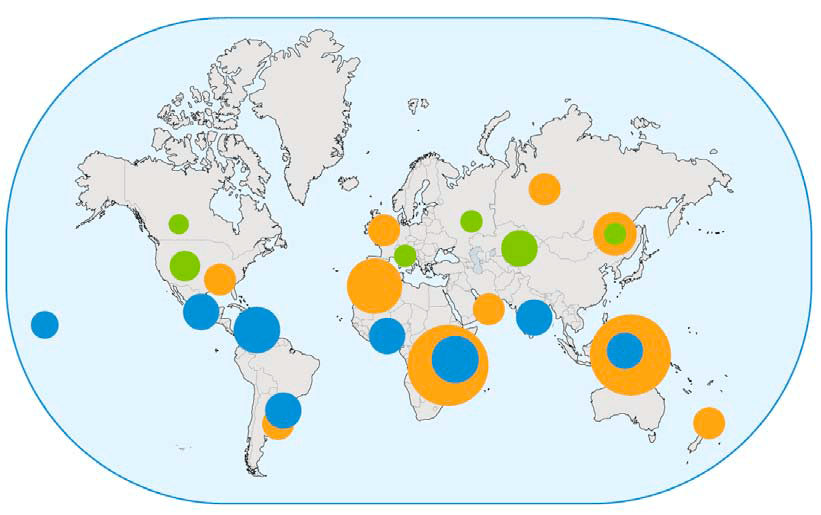
                                     Optimum land for growing biofuel sustainably

    ATAG
    Source: ATAG

    Circle sizes are estimates of potential locations for new generation biofuel feedstock production.

  • They do not have an impact on food prices: Since conventional biofuels like corn and sugar are also used as food for us, and farmers can get better prices for their corn and sugar if they sell them to biofuel refiners, leading to volatile food prices. Hartmut Michel, Nobel Prize winner, explains, that when you have “energy plants” competing with food plants, we are all worse off.
  • They feed off CO2: According to Jansson, Wullschleger, Kalluri, & Tuskan, human activities are responsible for an annual emission of 9 gigatons of carbon (33 gigatons of CO2). Whilst terrestrial and oceanic systems manage to absorb 3 and 2 gigatons respectively, leaving the remaining 4 gigatons in the atmosphere making algae ideal for carbon capture from sources like power plants.
  • Fast Oil Production Rate: One of the biggest advantages of algae for oil production is the speed at which they can grow. Some studies estimated that algae produce up to 15 times more oil per square kilometer than others pointed to algae strains that produced biomass very rapidly, with some species doubling in as few as 6 h, and many exhibiting two doublings per day.

So the promise of algae oil is tantalizing: it’s like the silver bullet.

In a nutshell: scientists were meant to identify a strain of algae to be genetically modified to produce lipids (oils) very quickly while feeding on carbon dioxide from the atmosphere. The lipids would be harvested and converted into usable oil while they ducked carbon from the atmosphere. And all this was meant to be economical and scalable.

  🔥 From 2003-2012: The Hype Was On🔥

Turning pond scum into a petroleum-like fuel is both laborious and expensive, yet the end goal was very alluring. As Eric Wesoff ironically puts it, “dozens of companies managed to extract hundreds of millions in cash from VCs in hopes of ultimately extracting fuel oil from algae”.

Researchers and algae oil companies were making huge claims about the promise of algae-based biofuels; the U.S. Department of Energy caught on early and was also making big bets through its bioenergy technologies office; industry advocates claimed that commercial algae fuels were scalable in the near-term and investors jumped the gun.

In 2006, there were a meager handful of specialized companies devoted to commercializing algae biofuel. By 2008 there are over 200, most of which had been active for less than a year. While most of these were angel investor or venture capital backed, there were also some bigwigs that took a stab at developing algae biofuels, such as Shell, Johnson Mathey, General Atomic, Boeing, Honeywell, DuPont, BP, and others.

However, in spite of optimistic investors and bold promises, a few hard truths began to transpire.  It became clear that whilst the technology was indeed “promising”, scaling it in a time frame relevant to our needs at an economic price was not within reach, anytime soon.

Cracks began to show in investment patterns as Exxon Mobil decided to invest $600 million into a joint venture with Craig Venter’s Synthetic Genomics for research into algal fuels, which they quickly scaled back to $300m and then to $100m. Another star player, Sapphire Energy, an algae biofuel start-up, which raised over $100 million in venture capital, including from Bill Gates’ investment firm Cascade Investment, has pivoted away from algae fuel and is now producing omega-3 oils and animal feedstock, while the famous startup GreenFuel, which grew out of Harvard and MIT research, went bust blowing through $70 million.

In the meantime, the surviving algae oil companies have shifted their core business and “branched out” to produce more economically sustainable co-products, like supplements, algae cosmetic oil, pigments and animal feedstocks and products for the pharmaceutical and chemical industry. Here is a list of algae oil companies that have been forced to move away from algae oil.

 So what went wrong?

I think that many stakeholders were blindsided by the great potential of the technology. To date, no company has been able to grow algae at the large enough scale required to produce meaningful quantities of a fuel, affordably. While there are many hurdles, I identified these two main reasons:

  • The basic science behind its cultivation:
    • The first part of the life cycle of the algae turned out to be burdened by obstacles.  As companies developing these algae have attempted to scale up, problems emerged which they could not have anticipated, including the emergence of competitor algae, predators such as microscopic animals that ate the algae, the occurrence of algae diseases in the form of bacteria and fungi and temperature fluctuations, which could kill the algae.
    • Whilst algae can grow quickly, the can do so only in the presence of sufficient nutrients. Algae can obtain carbon, their primary nutrient from atmospheric carbon dioxide, but the amounts present are insufficient to promote the rapid growth that was observed under lab conditions. That requires something more than 10% CO2 concentration in the atmosphere and in fact some of the earliest attempts to grow algae as a fuel source were predicated upon the development of pervasive industrial carbon dioxide capture.

  • Energy Return on Energy Invested:
    Researchers who looked at life-cycle analysis and the EROI/EROEI found algae biofuels would not have a positive energy balance, in other words, you’d have to put more energy in cultivating, harvesting, refining and transporting the algae biofuel than you would get out of it once it’s burned.

    c458bd8454b21bcc39f8255059793d11aabdc4f7
    EROI is a straightforward and simple concept to get your head around, and it is defined as the energy contained in one unit of fuel divided by the total nonrenewable energy required to produce one unit of fuel. It’s a way of getting a handle on how energy-efficient your energy production is.

    The breakeven point is 1. When the EROI is 1 there is no return on the energy invested, and the entire investment has been wasted. When the EROI ratio is higher, it also signals that the energy from that source is easy to get and cheap. Conversely, when the number is small, the energy from that source is difficult to get and expensive.

    Now, I will be the first to admit that there is no consensus on the methodology used to calculate either Life Cycle Analysis or EROI, making calculations on it is somewhat abstract. In part, it depends on what one counts as an “input”, and neither energy companies nor biofuel producers report detailed information on their energy consumption, resulting in researchers generating assumptions in order to calculate them.  To calculate the energy input, researchers have to make an estimate based on the dollars spent on various processes and goods, which means that two reports calculating EROI will likely yield different results, because of the different variables used.

    In spite of this ambiguity, The National Academy of Sciences (Chapter 8 NAS 2012) concludes: “An energy return on investment (EROI) of less than 1 is definitely unsustainable. An algal biofuel production system would have to have or at least show progress toward EROI within the range of EROI required for the sustainable production of any fuel (Pimentel and Patzek, 2005). Algal biofuels would have to return more energy in use than was required in their production to be a sustainable source of transportation. Microalgal fuels use high-value energy inputs such as electricity and natural gas. If these high-quality energy sources are downgraded in the production of algal fuels, it is certainly a sustainability concern that can only be truly understood through careful life-cycle analysis. EROI of 1, the breakeven point, is insufficient to be considered sustainable. However, the exact threshold for sustainability is not well defined. Hall (2011) proposed that EROI greater than 3 is needed for any fuels to be considered a sustainable source. EROI can be estimated with an LCA that tracks energy and material flow”.

    Here is a look at the available literature on Algae EROI:

    EROIbio.PNG
    Source: Quantitative Uncertainty Analysis of Life Cycle Assessment for Algal
    Biofuel Production, 2012

The studies that gave algae biofuel a positive EROI depended on co-products (something produced along with a main product which carries equal importance as main product, for the pharmaceutical, animal feed, and chemical industry) to tip the balance from a negative energy return to a positive.  But the Department of Energy pointed out “if biofuel production is considered to be the primary goal, the generation of other co-products must be correspondingly low since their generation will inevitably compete for carbon, reductant, and energy from photosynthesis…and coal-fired power plant carbon dioxide”.

So far, nobody has been able to make fuel from algae for a cost anywhere close to cheap, let alone competitive. Companies are trying to overcome these problems, but we will not be seeing companies selling large amounts of algae biofuels anytime soon.

tl:dr -> Cool idea, but due to unreliable cultivation methods, large nutrient requirements (of carbon, nitrogen, and phosphorus), low EROI, high capital costs, and competition from below $50 petroleum, the technology isn’t close to being ready.


Reading up on the EROI was very interesting so you might be keen on it too. Check out the following sources:

Peakoil.com,. (2014). EROEI as a Measure of Biofuel Effectiveness

Epa.gov. (2010). Renewable Fuel Standards Program Regulatory Impact Analysis Office of Transportation and Air Quality: The United States Environmental Protection Agency.

Inman, M. (2014). Behind the Numbers on Energy Return on Investment.