The Siemens-Gamesa Merger

Following several rounds of consolidations by their competitors in the energy sector including General Electric’s purchase of Alstom’s energy business and a merger between Germany’s Nordex and Spanish rival Acciona Wind Power, Siemens and Gamesa have announced their merger.

Siemens and Spain’s Gamesa agreed last week to merge to create the world’s biggest manufacturer of wind farms, with the German company paying 1 billion euros ($1.13 billion) for a majority stake in the combined business. The combined group’s order portfolio would be worth some 20b euros. The merged business will have 21,000 employees, an installed power base of 69 gigawatts.

Before the merger

Before their merger, Siemens had an 8% share of the global wind turbine market, according to data from FTI Consulting, which made it the second-biggest manufacturer after Denmark’s Vestas, which had a share of nearly 12%.

But Gamesa’s relatively small 4.5% market share put it steadily behind other large players, such as China’s Goldwind, which has been growing internationally into fast-growing renewable energy markets in Latin America, as well as the parts of the US and Europe.

271031
Wind Turbine Manufacturers by Market Share 2015,
www.statista.com 

The Siemens-Gamesa merger

The Siemens-Gamesa merger would create a new global market leader in wind energy by capacity, surpassing China’s Goldwind, Denmark’s Vestas and General Electric, according to FTI Consulting.

The merger is broadly considered a win-win in that this move would bring together Siemens’ strength in offshore wind power in mature markets and Gamesa’s leading role in emerging markets.

Each has their own competitive advantage

More specifically, Siemens operates in the mature North American and European markets and whereas Gamesa’s turf are the fast-growing markets such as India, Mexico, and Brazil. 

Moreover, Siemens’s wind division, which had almost €6 billion in revenue in 2015, manufactures and installs wind turbines for on- and offshore farms. But the business has been largely focused on the offshore market—where it has a large order backlog for turbines—while fumbling on onshore growth opportunities. Gamesa is also a major player across South America, where it expanded when the Spanish government cut subsidies to clean energy producers in 2013 as well as China and India, where it is the number one foreign producer.

Siemens is known to all of us as a quality engineering company (whose other products include trains, medical body scanners, and technical instruments), but it has struggled to make its wind turbine business profitable. After the merger, it will take a 59 % stake in the company but it will not have a majority on the board but will have five out of the 13 board members in the new group.

Their deal states that in return for Siemens becoming majority shareholder, Siemens will pay Gamesa’s shareholders, which include Spanish utility firm Iberdrola, 1b euros in cash in the form of an extraordinary dividend.

The businesses will be combined within Gamesa which will retain its Madrid headquarters. The Spanish group is creating new shares to be offered to Siemens.

Gamesa has further affirmed that the merged business will be operational by March- April 2017  and will be worth 230m euros of earnings before interest and taxes (EBIT) within four years due to the cost and savings strategy that is being implemented. The idea is that getting bigger would also help to lower costs, one of the industry’s key targets in its race for more efficient turbines, which in turn will make it more competitive. 

And then there’s Dong

It’s hard to find a comparable energy company to Dong, the world’s largest developer and operator of offshore wind farms and European poster child for the transition from fossil fuels to green energy. Dong Energy is looking to sell a stake of approx. 17% which could value the company at €16bn.

Winds of Change: Move from black to green

Over decade ago, Dong Energy was one of Europe’s most coal-intensive utilities, providing thermal    electricity to its customers.It was also very active in offshore oil and gas exploration and extraction in Norway and Scotland.

In recent years,  the company embarked on an energy transition strategy and began selling off coal-fired assets and a part of its oil and gas business. For the past few years, their vision has been to reduce their energy generation from coal and transition to wind energy, becoming world’s biggest offshore wind company and are aiming to double their installed capacity from 3.0 gigawatts in 2016 to 6.5 gigawatts by 2020, equivalent to the annual electricity consumption of 16m people.

Dong CAPEX
Dong Investor Presentation, March 2016


According to their March 2016 Investor Presentation, towards 2020, they expect to allocate 80% of their capital investment to wind, 10-15% to biomass conversation and investments into the power grid. Finally, an ever shrinking 5-10% is targeted towards oil and gas.

Chief Executive Officer Henrik Poulsen, had this to say regarding their transition, “Fundamentally it is a strong portfolio. However, we see simply better risk-return opportunities in the renewables business, and therefore we are managing the oil and gas business for cash and reallocating that cash back into renewables.”

However, there is no denying that Denmark today is still reliant on oil, coal and gas. Make no mistake, was it not for the North Sea oil fields, the Danish success story might have looked very different. Since the 1990s, the oil and gas driven from the seabed north of Denmark have made the Danes quasi-self-sufficient with oil and gas, while simultaneously boosting the Danish economy. But the Danish energy story is changing, the investment strategy clearly trends towards RE and away from fossil fuels.

Coming Soon: June 9th, 2016 Dong Energy IPO

On Thursday, 9th June, Dong will look to sell a stake of as much as 17.4% in an IPO that may value the company as high as 106.5 billion kroner (€16 billion) for 200 to 255 kroner (€26-34) per share, thus making this the largest IPO this year.  Previously, Dong tried and stopped three past attempts to list from 2006 to 2008 due to market turmoil and other difficulties, but this time, they are marching ahead.

However, what’s special about Dong is that unlike any other large energy company, 75 % of its capital is already employed in wind power generation. While Dong has a small but active oil and gas business, it’s clear this is trending toward being a triviality in the overall core business mix.

Traditionally, investors interesting in exposure to RE through large companies typically have to invest in a traditional energy company whose diversification into clean energy is still small relative to their conventional power assets, but Dong has practically already transitioned. Moreover, the high quality domestic Danish power distribution network provides the stable revenue returns which are very reassuring to their investors. This signals that they can support investment in its core wind business.

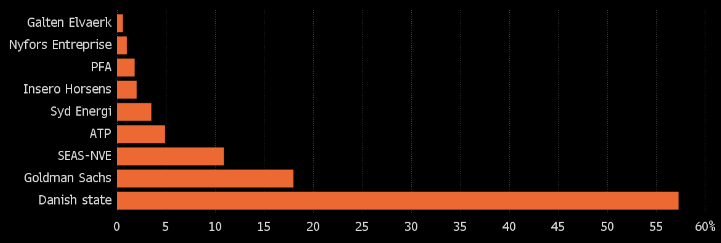
Owners of Dong Energy
Owners of Dong in %, Bloomberg


The Danish government now holds 59% of Dong and plans to maintain a holding of 51% after the IPO. Goldman Sachs with an 18% stake underscored its commitment to being a long-term partner in the future of the company.

Here are the take home messages that I think are valuable to keep in mind in the wake of their IPO:

1. Dong has access to very low-cost capital, especially in a macro backdrop where policy makers are incentivizing clean energy

2. Dong needs capital investment to ensure healthy returns to their shareholders

3. Dong’s objective, via this IPO is to share out the capital expenses through its partners

4. Dong’s distribution, generation and storage assets, can provide their grid resiliency in the cases of intermittency.